 Get New Issue Alerts
Browse Archive
- Vol 34 Issue 2
- Vol 34 Issue 1
- Vol 33 Issue 4
- Vol 33 Issue 3
- Vol 33 Issue 2
- Vol 33 Issue 1
- Vol 32 Issue 4
- Vol 32 Issue 3
- Vol 32 Issue 2
- Vol 32 Issue 1
- Vol 31 Issue 4
- Vol 31 Issue 3
- Vol 31 Issue 2
- Vol 31 Issue 1
- Vol 30 Issue 4
- Vol 30 Issue 3
- Vol 30 Issue 2
- Vol 30 Issue 1
- Vol 29 Issue 4
- Vol 29 Issue 3
- Vol 29 Issue 2
- Vol 29 Issue 1
- Vol 28 Issue 4
- Vol 28 Issue 3
- Vol 28 Issue 2
- Vol 28 Issue 1
- Vol 27 Issue 4
- Vol 27 Issue 3
- Vol 27 Issue 2
- Vol 27 Issue 1
- Vol 26 Issue 4
- Vol 26 Issue 3
- Vol 26 Issue 2
- Vol 26 Issue 1
- Vol 25 Issue 4
- Vol 25 Issue 3
- Vol 25 Issue 2
- Vol 25 Issue 1
- Vol 24 Issue 4
- Vol 24 Issue 3
- Vol 24 Issue 2
- Vol 24 Issue 1
- Vol 23 Issue 4
- Vol 23 Issue 3
- Vol 23 Issue 2
- Vol 23 Issue 1
- Vol 22 Issue 4
- Vol 22 Issue 3
- Vol 22 Issue 2
- Vol 22 Issue 1
- Vol 21 Issue 4
- Vol 21 Issue 3
- Vol 21 Issue 2
- Vol 21 Issue 1
- Vol 20 Issue 4
- Vol 20 Issue 3
- Vol 20 Issue 2
- Vol 20 Issue 1
- Vol 19 Issue 4
- Vol 19 Issue 3
- Vol 19 Issue 2
- Vol 19 Issue 1
- Vol 18 Issue 4
- Vol 18 Issue 3
- Vol 18 Issue 2
- Vol 18 Issue 1
- Vol 17 Issue 4
- Vol 17 Issue 3
- Vol 17 Issue 2
- Vol 17 Issue 1
- Vol 16 Issue 3
- Vol 16 Issue 2
- Vol 16 Issue 1
- Vol 15 Issue 3
- Vol 15 Issue 2
- Vol 15 Issue 1
- Vol 14 Issue 3
- Vol 14 Issue 2
- Vol 14 Issue 1
- Vol 13 Issue 3
- Vol 13 Issue 2
- Vol 13 Issue 1
- Vol 12 Issue 3
- Vol 12 Issue 2
- Vol 12 Issue 1
- Vol 11 Issue 3
- Vol 11 Issue 2
- Vol 11 Issue 1
- Vol 10 Issue 3
- Vol 10 Issue 2
- Vol 10 Issue 1
- Vol 9 Issue 3
- Vol 9 Issue 2
- Vol 9 Issue 1
- Vol 8 Issue 3
- Vol 8 Issue 2
- Vol 8 Issue 1
- Vol 7 Issue 3
- Vol 7 Issue 2
- Vol 7 Issue 1
- Vol 6 Issue 3
- Vol 6 Issue 2
- Vol 6 Issue 1
- Vol 5 Issue 3
- Vol 5 Issue 2
- Vol 5 Issue 1
- Vol 4 Issue 3
- Vol 4 Issue 2
- Vol 4 Issue 1
- Vol 3 Issue 3
- Vol 3 Issue 2
- Vol 3 Issue 1
- Vol 2 Issue 3
- Vol 2 Issue 2
- Vol 2 Issue 1
- Vol 1 Issue 3
- Vol 1 Issue 2
Social Anthropology
Anthropologie sociale
ISSN: 0964-0282 (print) • ISSN: 1469-8676 (online) • 4 issues per year
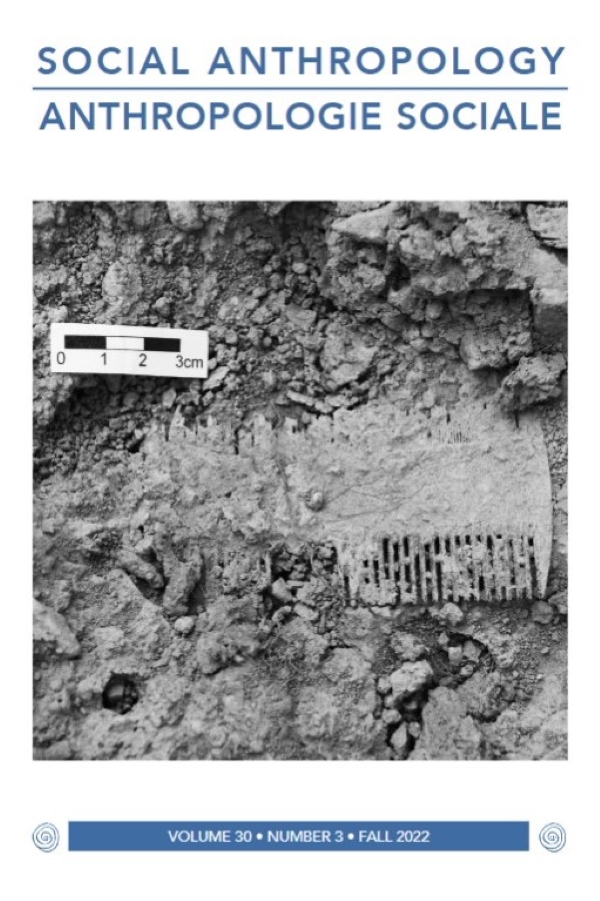
Volume 30 Issue 3
When Food Waste Goes to Work
A New Flavour for the EU's Circular Economy
Food waste is embroiled in a wide array of social efforts and actions in the contemporary EU. This article considers one site in the EU's capital where surplus supermarket food that is no longer sellable but is still edible is being used to fuel a job training programme. It argues that, rather than understanding the state's role in this process as a purely neoliberal tactic or as a capitalist profit-driven action, the repurposing of discarded food in order to create job opportunities and feed new populations has moral contours and enables specific forms of care.
Humour and the Plurality of Everyday Life
Comical Accounts from an Interface Area in Belfast
This article examines self-referential humour in narrative accounts about experiences of conflict and community division, based on fieldwork undertaken in an interface area in Belfast in the late 2000s and in the 2010s. It has been a classic approach within anthropological studies of humour and jokes to focus on their socially or politically subversive nature. Some anthropologists, however, have viewed this approach sceptically, pointing out the Janus-faced nature of laughter that can turn against the weak, or the ambiguity that humour carries. Sharing the understanding that ambivalence and ambiguity are humour's intrinsic features, this article argues that these very features make humour crucial to people's everyday recollections and interactions in a post-conflict, still-much divided, society. Self-comicalisation helps people produce distance, either from themselves or the social group to which they belong, and direct attention to the absurdity of daily life under a long-term conflict in which mundane, day-to-day concerns and intense violence and suffering all flow in parallel. Jokes and comical storytelling capture this plurality of everyday life, which can be shared across the community division. Through attempting to sound out what could and could not be joked about, moreover, people seek out possible interactions in unfamiliar and uncertain relationships.
Editorial
In July 2022, at the EASA meetings in Belfast, we passed the baton to a new editorial team comprising Chief Editors Dimitra Kofti (Panteion University of Social and Political Sciences, Athens) and Isabelle Rivoal (University of Paris, Nanterre) as well as Assistant Editor Ville Laakkonen (Tampere University) and Book Review Editor Arne Harms (Max Plank Institute for Social Anthropology). The new team has started to process new submissions and will introduce itself in one of the first editorials of 2023. We look forward to their contribution to this distinguished journal and wish them a felicitous term of office.
Introduction
Anthropologies of Forensic Expertise in the Aftermath of Mass Violence
In recent (post-)conflict scenarios, the diversity and complexity of mass violence, including acts of enforced disappearance and extrajudicial or summary executions, have transformed how knowledge about such crimes is performed and produced socially. In inquiries into human rights violations, the search for, exhumation and identification of missing bodies often buried in mass graves have led distinct applications of forensic work to emerge. These have some differences from traditional crime scene investigation approaches. Novel interactions between forensic science practitioners and the communities where they operate have given place to unprecedented sociocultural, affective and scientific understandings of evidencing mass crimes. Drawing on different ethnographic experiences of unearthing human remains around the world, this collection considers how, in its judicial but also its extrajudicial application, forensic expertise has been transformed in connection to other epistemologies, collective and individual mourning, kinship, memory and a new politics and ethics of care in distinct state- and civil society-led pursuits to account for the dead and missing.
Dans les scénarios récents de (post-)conflit, la diversité et la complexité de la violence de masse (y compris les actes de disparition forcée et les exécutions extrajudiciaires ou sommaires) ont transformé la manière dont la connaissance de ces crimes est acquise et produite socialement. Dans le cadre des enquêtes sur les violations des droits de l'homme, la recherche, l'exhumation et l'identification des corps disparus, souvent enterrés dans des fosses communes, ont suscité l'émergence d'applications distinctes du travail médico-légal. Celles-ci diffèrent des approches traditionnelles des enquêtes sur les scènes de crime. Les nouvelles interactions entre les praticiens de la médecine légale et les communautés où ils opèrent ont donné lieu à des compréhensions de la mise en évidence des crimes de masse socioculturelles, affectives et scientifiques sans précédent. En s'appuyant sur différentes expériences ethnographiques de mise au jour de restes humains à travers le monde, cette collection examine comment, dans son application judiciaire mais aussi extrajudiciaire, l'expertise médico-légale a été transformée en relation avec d'autres épistémologies, le deuil collectif et individuel, la parenté, la mémoire, ainsi qu'une nouvelle politique et une nouvelle éthique de la prise en charge dans le cadre des efforts distincts menés par l'État et la société civile pour rendre compte des morts et des disparus.
(Un)Doing the Colombian Armed Conflict
Forensic Knowledge, Contradicting Bodies, Unsettling Stories
In 2005, Colombia enacted the Justice and Peace Law, which was a transitional framework for addressing the legal status of demobilised members of the paramilitary group
En 2005, la loi sur la justice et la paix a été promulguée en Colombie. Il s'agissait d'un cadre transitoire permettant de régler le statut juridique des membres démobilisés du groupe paramilitaire Autodefensas Unidas de Colombia [Autodéfenses unies de Colombie] et d'autres groupes armés. Cette loi prévoyait la réduction des peines de prison en échange de renseignements sur l'emplacement des corps des personnes que ces groupes avaient enlevées et tuées. Des experts médico-légaux du bureau du procureur étaient chargés d'exhumer et d'identifier les corps. Cela les plaçait au centre de la scène en tant que source de preuves scientifiques, de témoignages et d'autorité, en raison de leur objectivité présumée et de leur approche non préjudiciable. Cependant, la connaissance médico-légale, comme toute connaissance, est située, partielle et performative. Je m'intéresse ici aux effets des connaissances médico-légales sur le droit des victimes à la vérité, les pratiques de mémoire et l'administration de la justice dans le cadre de la loi Justice et Paix en Colombie. Je soutiens que les connaissances médico-légales coproduisent des conflits en produisant des victimes et des auteurs dont les identités et les histoires peuvent être en contradiction avec d'autres récits de la violence qui s'est produite.
Unearthing Unknowns
The Forensic Practice and Memory Politics of Korean War Disinterments
Over 7,500 American service members are unaccounted for from the Korean War, a legacy of the so-called forgotten war of the past century. But shifting political winds surrounding the US government's care for war dead have breathed new life into the fading memory of these particular unnamed. Through the development of a systematic disinterment programme aimed at meeting congressional goals for the US military's Missing In Action (MIA) accounting mission, the absent war dead from the Korean peninsula have ignited new debates over obligations to these missing combatants and their surviving kin. This article examines both the evolving forensic practice of the MIA accounting efforts as well as the bureaucratic attention now trained on the heretofore ‘forgotten’ missing. The commemorative and scientific interventions into the legacy of this past conflict reveal how the reappeared and returned dead become conscripted into projects of strategic national remembrance.
Dans l'héritage de ce que l'on appelle la guerre oubliée du siècle dernier, il y a 7 500 militaires américains de la guerre de Corée portés disparus. Mais l'évolution de la politique du gouvernement américain en matière de soins aux morts de la guerre a donné un nouveau souffle à la mémoire de ces inconnus. Grâce au développement d'un programme d'exhumation systématique visant à atteindre les objectifs du Congrès en matière de comptabilisation des personnes disparues au combat (MIA) par l'armée américaine, les morts de guerre absents de la péninsule coréenne ont suscité de nouveaux débats sur les obligations envers ces combattants disparus et leurs parents survivants. Cet article examine à la fois l'évolution de la pratique médico-légale des efforts de comptabilisation des MIA et l'attention bureaucratique désormais portée aux disparus jusqu'alors « oubliés ». Les interventions commémoratives et scientifiques sur l'héritage de ce conflit passé révèlent comment les morts réapparus et revenus au pays sont enrôlés dans des projets de commémoration nationale stratégique.
Managing Mass Graves in Rwanda and Burundi
Vernaculars of the Right to Truth
The governments of Rwanda and Burundi exhume mass graves with the promise of revealing truths about the contested histories of past conflict and genocide. In Rwanda, exhumations recover and conserve the bodies of victims of the genocide against the Tutsi. Since December 2019, the Truth and Reconciliation Commission in Burundi has also begun mass exhumations; these efforts are motivated by truth-seeking and reconciliation aspirations that articulate a specific narrative of victimhood and state legitimacy. The state employs vernacularised forms of forensic practices and ‘international’ rights-based discourses in both cases. Drawing on our respective ethnographic fieldwork, we describe and analyse exhumation practices in Rwanda and Burundi. The ‘forensic turn’ in post-conflict settings has been the subject of much discussion and debate among scholars since the proliferation of the practice over recent decades. We add to these debates in our consideration of two linked settings in which the exhumations had become powerful political tools, in this case serving as a source of power for specific regimes.
Les gouvernements du Rwanda et du Burundi exhument des fosses communes en promettant d'éclaircir les vérités sur les histoires contestées des conflits et des génocides passés. Au Rwanda, les exhumations ont été organisée pour récupérer et conserver les corps des victimes du génocide contre les Tutsis. Depuis décembre 2019, la Commission Vérité et Réconciliation au Burundi a également entamé des exhumations de masse ; ces efforts sont motivés par des ambitions de recherche de la vérité et de réconciliation articulées autour d'un récit spécifique de victimisation et de légitimation de l'État. Dans les deux cas, l'État utilise des formes vernacularisées de pratiques médico-légales et des discours « internationaux » fondés sur les droits. En nous appuyant sur nos travaux ethnographiques de terrain respectifs, nous décrivons et analysons les pratiques d'exhumation au Rwanda et au Burundi. Le tournant médico-légal » dans les contextes post-conflits a fait l'objet de nombreuses discussions et débats parmi les chercheurs depuis la prolifération de ces pratiques au cours des dernières décennies. Nous contribuant à ces débats en examinant deux contextes liés dans lesquels les exhumations sont devenues de puissants outils politiques, servant dans ce cas de source de pouvoir pour des régimes spécifiques.
Situating the Investigation on Clandestine Graves in Mexico
Between the Forensic and Affective Turns
Over 90,000 people have been disappeared as a result of the War on Drugs that takes place in Mexico. Most of them are young people from poverty-stricken communities, stigmatised and targeted by an ongoing military campaign for their alleged connection to ‘organised crime’. Drawing on the experience of the search for bodies in hidden mass graves initiated by a group of mothers of those who have disappeared in the state of Sinaloa (Mexico), this article aims to provide a comprehensive reflection of the emotional turn and the forensic turn, from a feminist perspective. Our ethnographic contribution focuses on how
Plus de 90 000 personnes ont disparu en raison de la guerre contre la drogue qui se déroule au Mexique. La plupart d'entre elles sont des jeunes issus de communautés pauvres, stigmatisés et ciblés par une campagne militaire permanente en raison de leurs liens supposés avec le « crime organisé ». S'appuyant sur l'expérience de la recherche de corps dans des fosses communes cachées initiée par un groupe de mères de disparus dans l'État de Sinaloa (Mexique), cet article vise à fournir une réflexion globale sur le tournant émotionnel et le tournant médico-légal, dans une perspective féministe. Notre contribution ethnographique se concentre sur la façon dont Las Buscadoras (les femmes qui cherchent) résistent aux actes rationnels liés au traitement légal et scientifique des cadavres par la mobilisation d'actions communautaires symboliques, rituelles et politiques qui révèlent de nouvelles formes de reconnaissance affective et de soins pour les morts. Nous soutenons que cela a donné lieu à une pluralité de pratiques et de significations autour de la vérité et de la justice.
Silent Stock
On Clandestine Mass Graves and their Legacies
Mass exhumations and the mass unearthing of dead bodies are quite new phenomena in the history of humankind. The ‘forensic turn’ has led various disciplines to pay renewed attention to the dead and not only to the death. For a couple of decades, social anthropologists have been urged to (re)consider the materiality of death. This return of the dead bodies
Les exhumations et la mise au jour massives de cadavres sont des phénomènes plutôt nouveaux dans l'histoire de l'humanité. Le tournant médico-légal a conduit diverses disciplines à accorder une attention renouvelée aux morts et pas seulement à la mort. Pour leur part, les anthropologues sociaux ont été incités depuis quelques décennies à (re)considérer la matérialité de la mort. Ce retour en masse des cadavres les a, par conséquent, amenés à se pencher sur la manière dont les cadavres sont traités dans des situations de catastrophes ou de crimes de masse, mais aussi à prendre conscience des divers silences et mécanismes de déni qui entourent durablement les fosses communes et les cadavres enterrés. Cette postface vise à réfléchir à la manière dont ces silences et ces dénis ont façonné notre champ disciplinaire et maintenu certains de ses angles morts.
The Politics of Equivalence
(Post)Colonial Care and Transnational Animal Welfare in Jordan
Transnational animal welfare NGOs working in Jordan enfold both animals and humans into their missions of care, making the claim that animal welfare is a form of human welfare. This approach requires making humans and animals equivalent enough to one another so that their lives, their economic prospects and their moral futures might be collectively addressed. In some cases, these ‘politics of equivalence’ draw on the legacies of dehumanisation and animalisation in colonial narratives of animal welfare; in others, it is a form of economisation and recalibration of life value. Tracing the central role of equivalence-making in transnational animal welfare work helps theorise how care is operationalised to be collective and efficient in global projects of aid. Collectivising human–animal care is in this case a highly effective politics of difference-making, collapsing the boundaries between human and animal life in Jordan while establishing difference between British and Jordanian life at the same time.
Les ONG transnationales de protection des animaux qui travaillent en Jordanie intègrent à la fois les animaux et les humains dans leurs missions de soins, affirmant que le bien-être animal est une forme de bien-être humain. Cette approche exige de rendre les humains et les animaux suffisamment équivalents les uns aux autres pour que leurs vies, leurs perspectives économiques et leur avenir moral puissent être abordés collectivement. Dans certains cas, ces “politiques d'équivalence” s'appuient sur l'héritage de la déshumanisation et de l'animalisation dans les récits coloniaux du bien-être animal ; dans d'autres, il s'agit d'une forme d'économisation et de recalibrage de la valeur de la vie. Le fait de retracer le rôle central de l'établissement d'équivalences dans le travail transnational de protection animale permet de théoriser la manière dont les soins sont opérationnalisés pour être collectifs et efficaces dans les projets d'aide mondiaux. La collectivisation des soins humains-animaux est dans ce cas une politique très efficace de création de différences, qui abolit les frontières entre les vies humaine et animale en Jordanie tout en établissant des différences entre les vies britannique et jordanienne.
Book Reviews
de Abreu, Maria José. 2021.
Agier, Michel. 2021.
Szántó, Diana. 2020.
Philipp Budka and Bridgit Bräuchler (eds.) 2020.
Rippa, Alessandro. 2020.