 Get New Issue Alerts
Browse Archive
- Vol 34 Issue 2
- Vol 34 Issue 1
- Vol 33 Issue 4
- Vol 33 Issue 3
- Vol 33 Issue 2
- Vol 33 Issue 1
- Vol 32 Issue 4
- Vol 32 Issue 3
- Vol 32 Issue 2
- Vol 32 Issue 1
- Vol 31 Issue 4
- Vol 31 Issue 3
- Vol 31 Issue 2
- Vol 31 Issue 1
- Vol 30 Issue 4
- Vol 30 Issue 3
- Vol 30 Issue 2
- Vol 30 Issue 1
- Vol 29 Issue 4
- Vol 29 Issue 3
- Vol 29 Issue 2
- Vol 29 Issue 1
- Vol 28 Issue 4
- Vol 28 Issue 3
- Vol 28 Issue 2
- Vol 28 Issue 1
- Vol 27 Issue 4
- Vol 27 Issue 3
- Vol 27 Issue 2
- Vol 27 Issue 1
- Vol 26 Issue 4
- Vol 26 Issue 3
- Vol 26 Issue 2
- Vol 26 Issue 1
- Vol 25 Issue 4
- Vol 25 Issue 3
- Vol 25 Issue 2
- Vol 25 Issue 1
- Vol 24 Issue 4
- Vol 24 Issue 3
- Vol 24 Issue 2
- Vol 24 Issue 1
- Vol 23 Issue 4
- Vol 23 Issue 3
- Vol 23 Issue 2
- Vol 23 Issue 1
- Vol 22 Issue 4
- Vol 22 Issue 3
- Vol 22 Issue 2
- Vol 22 Issue 1
- Vol 21 Issue 4
- Vol 21 Issue 3
- Vol 21 Issue 2
- Vol 21 Issue 1
- Vol 20 Issue 4
- Vol 20 Issue 3
- Vol 20 Issue 2
- Vol 20 Issue 1
- Vol 19 Issue 4
- Vol 19 Issue 3
- Vol 19 Issue 2
- Vol 19 Issue 1
- Vol 18 Issue 4
- Vol 18 Issue 3
- Vol 18 Issue 2
- Vol 18 Issue 1
- Vol 17 Issue 4
- Vol 17 Issue 3
- Vol 17 Issue 2
- Vol 17 Issue 1
- Vol 16 Issue 3
- Vol 16 Issue 2
- Vol 16 Issue 1
- Vol 15 Issue 3
- Vol 15 Issue 2
- Vol 15 Issue 1
- Vol 14 Issue 3
- Vol 14 Issue 2
- Vol 14 Issue 1
- Vol 13 Issue 3
- Vol 13 Issue 2
- Vol 13 Issue 1
- Vol 12 Issue 3
- Vol 12 Issue 2
- Vol 12 Issue 1
- Vol 11 Issue 3
- Vol 11 Issue 2
- Vol 11 Issue 1
- Vol 10 Issue 3
- Vol 10 Issue 2
- Vol 10 Issue 1
- Vol 9 Issue 3
- Vol 9 Issue 2
- Vol 9 Issue 1
- Vol 8 Issue 3
- Vol 8 Issue 2
- Vol 8 Issue 1
- Vol 7 Issue 3
- Vol 7 Issue 2
- Vol 7 Issue 1
- Vol 6 Issue 3
- Vol 6 Issue 2
- Vol 6 Issue 1
- Vol 5 Issue 3
- Vol 5 Issue 2
- Vol 5 Issue 1
- Vol 4 Issue 3
- Vol 4 Issue 2
- Vol 4 Issue 1
- Vol 3 Issue 3
- Vol 3 Issue 2
- Vol 3 Issue 1
- Vol 2 Issue 3
- Vol 2 Issue 2
- Vol 2 Issue 1
- Vol 1 Issue 3
- Vol 1 Issue 2
Social Anthropology
Anthropologie sociale
ISSN: 0964-0282 (print) • ISSN: 1469-8676 (online) • 4 issues per year
Volume 26 Issue 2
Portraits, characters and persons
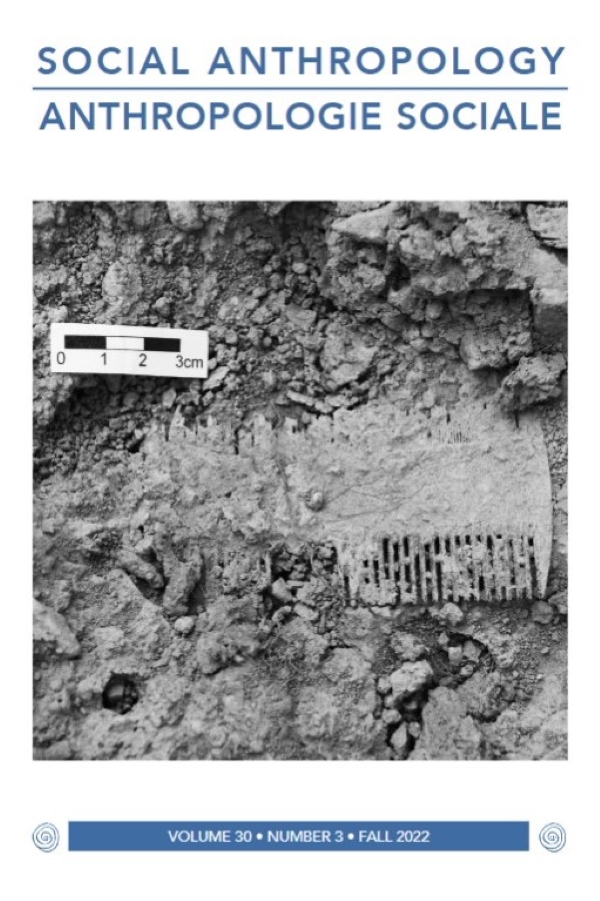
A recent experience of ‘returning’ photographs to acquaintances in Mt Hagen, Papua New Guinea, leads to questions about the recognition of character. People acknowledge characteristic ways of acting or behaving, but it is not at all clear that these are simply attached to individual persons. To what entity might such characteristics be attached, and what are the ethical repercussions? There seems something of a parallel between the way English‐speakers bundle together the elements of someone's character and how they might compose a portrait; indeed to the various senses of ‘character’ as specification of qualities, intrinsic nature or customary habit, one might add the work it does in ‘painting a portrait’, as the metaphor goes. A completely unlooked‐for response on the part of Hagen friends to my proposal to seek out people in order to give what in some cases I had thought of as portraits, namely photographs of themselves and close kin, forced me to think afresh about what it means to have pictures of persons. This in turn might throw some light on character as analytic.
Issue Information
On the character of character
An immodest proposal
Any revival of the anthropology of character (or its companion concept, ‘personality’) should avoid five chief faults of what has come before. First, it must be more cautious than many examples of the anthropology of character past in taking for granted that character can be generalised to the level of the ‘national’. Second, it should not fall back on a general psychology – whether of temperament or of the strategic actor. Third, it should take the complexity of character – from its embodiment and re‐embodiment in the individual to the plural and often competing and inconsistent collective demands of the formation of character that any given individual in any collective context must face – as its point of departure. Fourth, it should not privilege the homeostasis of the reproduction of character over the dynamics of the alteration of character. Fifth, it should avoid the anthropic as the only or even the chief domain of which judgements of character might be of anthropological interest. All of these requirements can potentially be met in approaching the analysis of character through extrapolating system‐theoretically from the logic of the Bourdieusian field.
Character as gift and erasure
For Southern Californian members of the Vineyard network of charismatic churches, character is a gift of God, traits bequested on them that are equal in dignity and importance to the classical divine gifts such as tongues, prophecy, healing or casting out demons. The chief difference is that these more classical gifts are not about gaining or valuing character traits, but about submission to God, and therefore are as much moments of character's erasure as they are of elaboration. And both forms of character, as perduring divine gift or as an ascetically earned moral character shaped through submission, help believers understand character in a third sense: as their being participants, and therefore personages, in the wider Gospel narrative of cosmic salvation.
The price of impact
Reflections on academic outreach amid the ‘refugee crisis’
Ever since the ‘refugee crisis’ hit European shores, policymakers, journalists and politicians have sought out knowledge on ‘unwanted’ migration and ‘what to do about it’. As influential people knock on academic doors – at times seeking out anthropologists, such as this author – how should we engage, and under what conditions? The seemingly endless rounds of panel debates, conferences and other policy‐focused outreach pull academics towards ‘high‐level’ engagements, while short‐term or politically driven ‘emergency’ funding pushes us towards narrowly defined research objectives. Meanwhile, the ‘impact’ agenda – most developed in the UK, yet increasingly encroaching on other academic ecosystems – is shifting institutional incentives towards specific forms of scholarly activity. This article builds an ‘auto‐ethnographic’ account of my own experiences of crossing the borders of anthropology at a time of perceived migratory crisis and increasing impact calls. Delineating the pitfalls and risks of ‘capture’ by policy agendas, the article argues for active navigation of the borderlands between academia and its various publics. For anthropologists to wrest some control, I suggest, we must be willing to take risks and get our hands dirty; strategically deploy our ethnographic sensibilities to the full; and stand ready to apply our analytical skills to powerful systems – including, not least, to the impact agenda itself.
Introduction to special section 1
Anthropology and character
This introductory essay seeks to reintroduce character to anthropological inquiry. Although it has long been out of favour due to its historical associations with accounts that attempt to describe national or ethnic character, we argue that a return of the under‐theorised concept may be in order. The essay invites socio‐cultural anthropologists to describe the diverse contexts in which character is recognised or enacted, out‐there‐in‐the‐world, and to become far more reflective about the ways in which characterization is deployed in our ethnographic writing. At the same time, it asks how the concept might be fruitfully operationalized at a meta‐language level to reorient current fields of anthropological study, without necessarily resorting to any collective or individual essentialisms. To illustrate the utility of re‐interrogating the concept, the question is addressed to two specific fields in which one might expect a concept such as character to already feature strongly: the anthropology of ethics and the anthropology of Christianity. What does an ethnographic attention to the ways in which character gets attributed reveal? How differently might these and other fields look if anthropologists embraced the concept of character or rejected it more knowingly? Finally, the essay asks what kinds of recombination of insights an anthropology and character approach might enable.
Becoming what you are
Faith and freedom in a Danish Lutheran movement
Based on fieldwork in the Danish protestant movement Tidehverv, this article explores what it means to try to live one's life according to a neo‐orthodox Lutheran and explicitly Kierkegaard‐inspired theology, whose overarching existential, social and political ideal is always to be true to oneself. Departing from the seemingly paradoxical notion that the essence of living a genuinely Christian life is ‘to become what you are’, as a Tidehverv priest put it, I seek to pin down the distinct concept of character, and wider concepts of personhood and temporality, upon which this ‘fundamentalist existentialist’ theology and ethics rest. This will involve discussing in some detail a number of core Kierkegaardian concepts such as ‘the moment’ (), the ‘decision’ () and ‘the leap’ (), and making a preliminary attempt to contextualise Tidehverv's existentialist project within the wider political, religious and cultural history of the modern Danish nation state. In doing so, the article offers an exploration of the relationships between Lutheran concepts of character and political expression, and between the concept of Christian individual character and Danish national character.
Moving alike
Movement and human–nonhuman relationships among the Runa (Ecuadorian Amazon)
In this paper I suggest that an analysis of movement can offer a fresh perspective through which to look at human–nonhuman relationships in Amazonia and beyond. Focusing on some examples from my ethnographic work among the Runa of the Ecuadorian Amazon, I explore how movement constitutes an important means through which similarity with nonhumans is constituted in everyday practice. Movement, as a common quality that human and nonhumans share, enables the Runa to consider themselves as ‘alike’ nonhuman others. In particular, I will show how self‐movement, understood as the awareness of one's own movement, is a central way in which Runa women align themselves to a spirit entity known as a the Grandmother of Clay.
Shah, Nafisa. 2016. Honour and violence: gender, power and law in southern Pakistan. New York: Berghahn Books. 302 pp. Pb.: US$29.95. ISBN: 9781785333651.
Ong, Aihwa. 2016. Fungible life: experiment in the Asian City of Life. Durham, NC: Duke University Press. 312 pp. Pb.: US$25.95. ISBN: 9780822362647.
High, Mette M. 2017. Fear and fortune: spirit worlds and emerging economies in the Mongolian gold rush. Ithaca, NY: Cornell University Press. 180 pp. Hb.: US$89.95. ISBN: 9781501707544.
Antweiler, Christoph. 2016. Our common denominator: human universals revisited. New York: Berghahn Books. 364 pp. Hb.: US$120.00. ISBN: 9781785330933.
Chatterji, Roma (ed.). 2015. Wording the world: Veena Das and scenes of inheritance. New York: Fordham University Press. 481 pp. Pb.: US$45.00. ISBN: 9780823261864.
Bon, Nataša Gregorič and Jaka Repič (eds.) 2016. Moving places: relations, return and belonging. New York: Berghahn Books. 240 pp. Hb.: US$110.00. ISBN: 9781785332425.
Calkins, Sandra. 2016. Who knows tomorrow? Uncertainty in North‐Eastern Sudan. Oxford: Berghahn Books. xi + 269 pp. Hb.: £85.00. ISBN: 978‐1‐78533‐015‐5.
Lowndes, Sarah. 2016. The DIY movement in art, music and publishing: subjugated knowledges. Abingdon: Routledge. 276 pp. Hb.: £110.00. ISBN: 9781138840751.
Power Camilla, Morna Finnegan and Hilary Callan (eds.) 2017. Human origins: contributions from social anthropology. Oxford: Berghahn Books. 356 pp. Pb.: £24.00. ISBN: 9781785334269.
Trnka, Susann and Catherine Trundle (eds.) 2017. Competing responsibilities: the ethics and politics of contemporary life. Durham, NC: Duke University Press. 272 pp. Hb.: US$94.95. ISBN‐13: 978‐0822363606.
Chrysagis, Evangelos and Panas Karampampas (eds.) 2017. Collaborative intimacies in music and dance: anthropologies of sound and movement. New York/Oxford: Berghahn. 282 pp. Pb.: US$120.00/£85.00. ISBN: 9871785334535.
Athanasiou, Athena. 2017. Agonistic mourning: political dissidence and the women in black. Edinburgh: Edinburgh University Press. 360 pp. Pb.: £13.99. ISBN: 9781474420150.
Editorial
Fillieule, Olivier and Guya Accornero (eds.) 2016. Social movement studies in Europe: the state of the art. Oxford: Berghahn Books. 526 pp. Pb.: £27.00. ISBN: 9781785330971.
Lueong, Glory M. 2017. The forest people without a forest: development paradoxes, belonging and participation of the Baka in East Cameroon. Oxford: Berghahn Books. 218 pp. Hb.: £64.00. ISBN: 978‐1‐78533‐380‐4.
Svašek, Maruška and Birgit Meyer (eds.) 2016. Creativity in transition: politics and aesthetics of cultural production across the globe. Oxford: Berghahn Books. 352 pp. Pb.: £24.00. ISBN: 9781785331831.
Bacigalupo, Ana Mariella 2016. Thunder Shaman: making history with Mapuche spirits in Chile and Patagonia. Austin: University of Texas Press. 288 pp. Pb.: $26.95. ISBN: 9781477308981.
Chakravarti, Leila Zaki. 2016. Made in Egypt: gendered identity and aspiration on the globalised shop floor. New York: Berghahn Books. 274 pp. Hb.: US$110. ISBN: 978‐1‐78533‐077‐3.
Binder, Susanne and Gebhard Fartacek (eds.) 2017. Facetten von Flucht aus dem Nahen und Mittleren Osten. Kultur‐ und Sozialanthropologie. Wien: Facultas. 320 pp. Hb.: €24.90. ISBN: 978‐3‐7089‐1452‐7.
Deomampo, Daisy. 2016. Transnational reproduction: race, kinship, and commercial surrogacy in India. New York: New York University Press. 288 pp. Pb.: US$30.00. ISBN: 9781479828388.
Naftali, Orna. 2016. Children in China. Cambridge: Polity Press. 192 pp. Pb.: US$22.95. ISBN: 978074568054‐5.
Widmer, Alexandra and Veronika Lipphardt (eds.) 2016. Health and difference: rendering human variation in colonial engagements. New York: Berghahn Books. 250 pp. Hb.: US$120.00. ISBN: 9781785332715.
Towards an anthropology of global inequalities and their local manifestations: social anthropology in 2017
At a time when political, social and environmental inequalities proliferate around the globe, anthropologists need to be equipped to diagnose, analyse and respond. This review of the anthropological research published in European journals in 2017 identifies three sets of tensions for an inquiry into global inequalities: first, between macro political economy processes and their localised workings/effects; second, between institutional processes of legitimisation and their everyday forms of resistance; and third, between future‐oriented projects of change and the political demands of the present. Taken together, these sets of tensions not only offer a starting point for analysing how global inequalities are locally channelled, experienced and acted on from below, but also point to the political and methodological challenges that anthropologists face in today's neoliberal climate of higher education.