 Get New Issue Alerts
Browse Archive
 PDF issue available for purchase
 Print issue available for purchase
- Vol 38 Issue 3
- Vol 38 Issue 2
- Vol 38 Issue 1
- Vol 37 Issue 4
- Vol 37 Issue 3
- Vol 37 Issue 2
- Vol 37 Issue 1
- Vol 36 Issue 4
- Vol 36 Issue 3
- Vol 36 Issue 2
- Vol 36 Issue 1
- Vol 35 Issue 4
- Vol 35 Issue 3
- Vol 35 Issue 2
- Vol 35 Issue 1
- Vol 34 Issue 4
- Vol 34 Issue 3
- Vol 34 Issue 2
- Vol 34 Issue 1
- Vol 33 Issue 3-4
- Vol 33 Issue 2
- Vol 33 Issue 1
- Vol 32 Issue 4
- Vol 32 Issue 3
- Vol 32 Issue 1-2
- Vol 31 Issue 4
- Vol 31 Issue 3
- Vol 31 Issue 1-2
- Vol 30 Issue 4
- Vol 30 Issue 3
- Vol 30 Issue 2
- Vol 30 Issue 1
- Vol 29 Issue 3
- Vol 29 Issue 2
- Vol 29 Issue 1
- Vol 28 Issue 3
- Vol 28 Issue 2
- Vol 28 Issue 1
- Vol 27 Issue 3
- Vol 27 Issue 2
- Vol 27 Issue 1
- Vol 26 Issue 3
- Vol 26 Issue 2
- Vol 26 Issue 1
- Vol 25 Issue 3
- Vol 25 Issue 2
- Vol 25 Issue 1
- Vol 24 Issue 3
- Vol 24 Issue 2
- Vol 24 Issue 1
- Vol 23 Issue 3
- Vol 23 Issue 2
- Vol 23 Issue 1
- Vol 22 Issue 3
- Vol 22 Issue 2
- Vol 22 Issue 1
- Vol 21 Issue 3
- Vol 21 Issue 2
- Vol 21 Issue 1
- Vol 20 Issue 3
- Vol 20 Issue 2
- Vol 20 Issue 1
- Vol 19 Issue 3
- Vol 19 Issue 2
- Vol 19 Issue 1
- Vol 18 Issue 3
- Vol 18 Issue 2
- Vol 18 Issue 1
- Vol 17 Issue 3
- Vol 17 Issue 2
- Vol 17 Issue 1
- Vol 16 Issue 3
- Vol 16 Issue 2
- Vol 16 Issue 1
- Vol 15 Issue 3
- Vol 15 Issue 2
- Vol 15 Issue 1
- Vol 14 Issue 3
- Vol 14 Issue 2
- Vol 14 Issue 1
- Vol 13 Issue 3
- Vol 13 Issue 2
- Vol 13 Issue 1
- Vol 12 Issue 3
- Vol 12 Issue 2
- Vol 12 Issue 1
- Vol 11 Issue 3
- Vol 11 Issue 2
- Vol 11 Issue 1
- Vol 10 Issue 3
- Vol 10 Issue 2
- Vol 10 Issue 1
- Vol 9 Issue 3
- Vol 9 Issue 2
- Vol 9 Issue 1
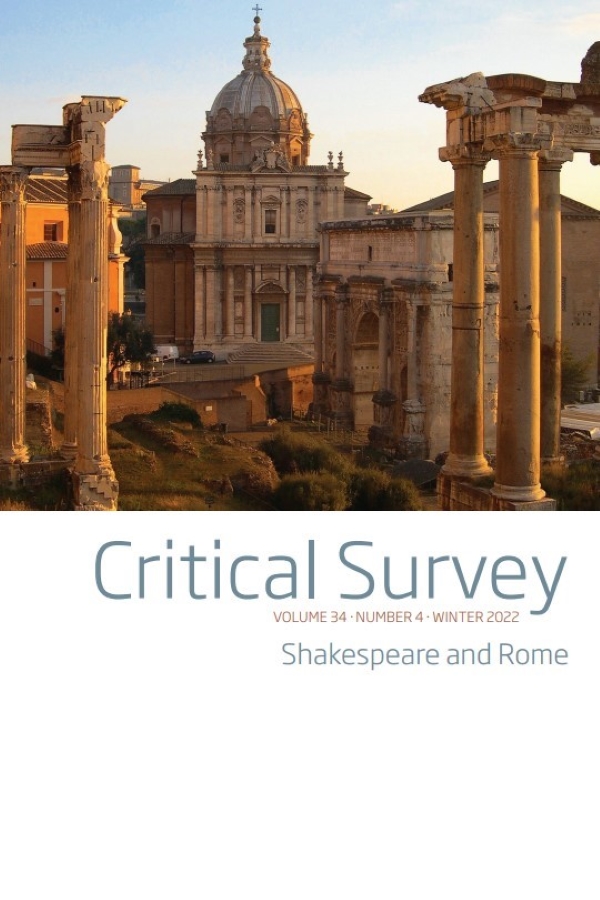
Critical Survey
ISSN: 0011-1570 (print) • ISSN: 1752-2293 (online) • 4 issues per year
Volume 34 Issue 4
Get 35% discount when you checkout 3 or more PDF articles.
Editorial
Shakespeare's interest in ancient Rome spans the whole of his dramatic career, from
The Question of Culpability in Shakespeare's Antony and Cleopatra
Revealing Cleopatra's Humanity
‘Is Antony or we in fault for this?’ Cleopatra asks Enobarbus, who is responsible for the loss at the Battle of Actium. Critics who find Cleopatra guilty take her supposed involvement in decision-making about the battlefield and escape from Actium as evidence of her culpability. Taking into consideration Antony's strong belief in Fate, this article proposes that Antony tacitly exculpates Cleopatra for his vanquishment in Actium and that Cleopatra's ‘flight’ is actually a tactical retreat rather than an action performed out of fear. This article also focuses on Cleopatra's relationship with her servants, which has received almost no critical attention. Drawing on the politeness and the speech act theories, I demonstrate how democratic, humble and grateful Cleopatra is in her treatment of her attendants.
Reflecting upon Coriolanus as Being-in-and-for-Mother through the Gaze of Existential Semiotics
This study applies Tarasti's existential semiotics, arguing that the protagonist of Shakespeare's
A Kingdom for a Mirth
Shakespeare's ‘Fatal Cleopatra’ and the Worm's Turn
This article offers a reading of the famously problematic scene 5.2 of
The Last Roman King
This article revisits one of Shakespeare's later, often rather neglected, plays. Shakespeare is thought to have written
‘Our Troy, our Rome’
Classical Intertextuality in
In
Ninagawa's Ancient Journeys
The Japanese director Ninagawa Yukio, who directed all four of the Roman plays between 2004 and 2014, noted the challenge he faced in making Shakespeare's Roman settings accessible for native audiences, his typical strategy being Japanisation. Ninagawa's Brechtian strategy works two ways in offering audiences a helpful perspective on cultural difference while harnessing Shakespeare's humanism to the anti-rational energies of his theatre that modernity had earlier suppressed. This article explores the mythopoeic aspect of Ninagawa's project first in the context of comparative religion and then with an analysis of his
Titus and Coriolanus in Tehran
Shakespeare's Roman Plays and Iran's Politics
Adaptations of Shakespeare's Roman plays have frequently addressed political topics at the time of their production. As a result, Shakespeare's Rome, already a site of political conflict and power struggle, has found different and at times opposing significations in its new contexts. The present study is set to explore how two recent adaptations of the Roman plays in Iran,
Nathaniel Lee's Politics of Sovereignty
This article explores the chaotic violence in Nathaniel Lee's tragedies, which, while clearly originating in the sovereign, by its sheer excess and blindness, is hypostasised as a motor of history. In Lee, violence is a reflection of the political anxieties surrounding the Exclusion Crisis but it is also intrinsic to the way he understands the nature of political life; in reality, it is constitutive of the very exercise of power. Drawing on Giorgio Agamben's