 Get New Issue Alerts
Browse Archive
- Vol 19 Issue 2
- Vol 19 Issue 1
- Vol 18 Issue 3
- Vol 18 Issue 2
- Vol 18 Issue 1
- Vol 17 Issue 3
- Vol 17 Issue 2
- Vol 17 Issue 1
- Vol 16 Issue 3
- Vol 16 Issue 2
- Vol 16 Issue 1
- Vol 15 Issue 3
- Vol 15 Issue 2
- Vol 15 Issue 1
- Vol 14 Issue 3
- Vol 14 Issue 2
- Vol 14 Issue 1
- Vol 13 Issue 3
- Vol 13 Issue 2
- Vol 13 Issue 1
- Vol 12 Issue 3
- Vol 12 Issue 2
- Vol 12 Issue 1
- Vol 11 Issue 3
- Vol 11 Issue 2
- Vol 11 Issue 1
- Vol 10 Issue 3
- Vol 10 Issue 2
- Vol 10 Issue 1
- Vol 9 Issue 3
- Vol 9 Issue 2
- Vol 9 Issue 1
- Vol 8 Issue 3
- Vol 8 Issue 2
- Vol 8 Issue 1
- Vol 7 Issue 2
- Vol 7 Issue 1
- Vol 6 Issue 2
- Vol 6 Issue 1
- Vol 5 Issue 2
- Vol 5 Issue 1
- Vol 4 Issue 2
- Vol 4 Issue 1
- Vol 3 Issue 2
- Vol 3 Issue 1
- Vol 2 Issue 2
- Vol 2 Issue 1
- Vol 1 Issue 2
- Vol 1 Issue 1
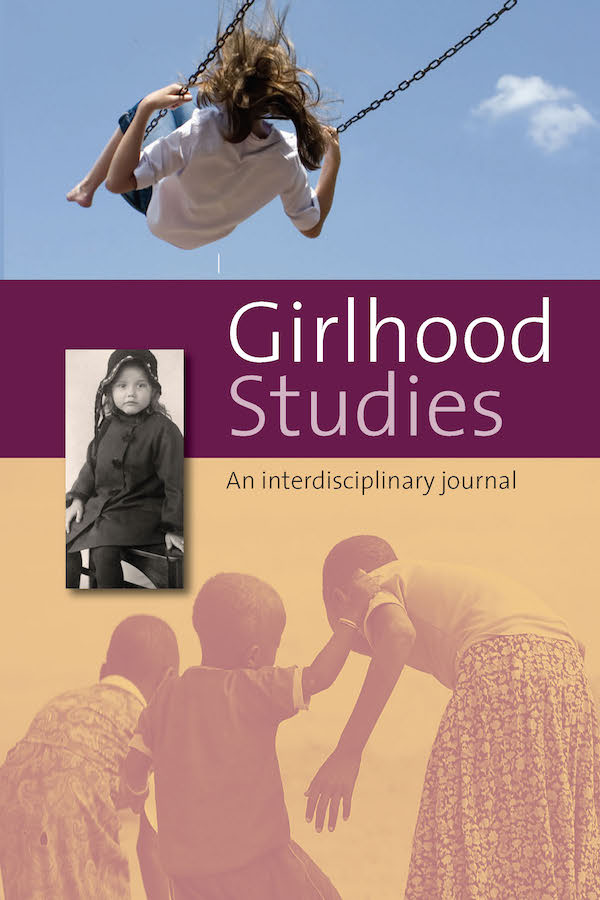
Girlhood Studies
An Interdisciplinary Journal
ISSN: 1938-8209 (print) • ISSN: 1938-8322 (online) • 3 issues per year
Volume 8 Issue 3
Rebellion and Resistance
There is something rebellious about the work of Girlhood Studies so it is perhaps fitting that “Visual Disruptions” is the theme of this seventeenth issue of Girlhood Studies. The significance of 17 as an age in the life of girls and young women may vary, of course, across cultures, and, indeed, within contemporary popular culture in the West it is not necessarily seen as disruptive, as research on Seventeen magazine highlights. Nonetheless, we can think of the Janis Ian song from the 1970s, “At Seventeen,” and the many songs from The Beatles to the Sex Pistols that refer to girls being 17, and contemplate a state that is far from compliant in relation to conventional femininity. The articles in this themed issue of Girlhood Studies, guest-edited by Danai S. Mupotsa and Elina Oinas, offer a fascinating investigation into the politics of girlhood and visual culture, and the politics of disruption itself. The contributions are also a testament to the close alliance between feminism and visual studies.
Visual Interruptions
In this themed issue we explore images that unsettle, disrupt, disqualify, and transgress the visual and affective expectations visited upon contemporary girls. The articles here suggest new ways of seeing, visualizing, and representing the girl, and of feeling and thinking about her. We begin from the recognition that girls are seduced into qualifying and passing in normative, intersecting ways that work along the various axes of sex, gender, age, corporeality, class, and race, and that we need to attend to possible disruptions of this logic. How do girls both entertain and interrupt the presumably obligatory wish to qualify? We attempt to answer this by looking at the intimate and embodied aspects of being a girl, and at the processes of estheticizing, and fetishizing the girly. We ask how the girl as subject-in-process establishes and challenges the notions of failing and passing.
Collecting Girlhood
Pinterest Cyber Collections Archive Available Female Identities
Collection is an important activity and marker of childhood. In this article I will discuss Pinterest as an online iteration of the collection process. Through Pinterest, users amass bits of information online, known as pins, to display on virtual bulletin boards. My project positions Pinterest as an influential text and literacy practice related to identity production with particular impact on girls. With obvious parallels to the keeping of commonplace books, Pinterest is an act of virtual curation that shapes a pinner's present and future identities. In the Pinterest space, girls see and collect ideals of femininity (displayed in recipes, fantasy weddings, and parenting tips) and in so doing create their own online avatars. This practice requires a critical awareness as users reinscribe, resist, or reinforce cultural norms of femininity. This article offers a conceptual base for future systematic study of Pinterest as a text and practice of girlhood.
Comics as Public Pedagogy
Reading Muslim Masculinities through Muslim Femininities in Ms. Marvel
In this article we examine the production and operation of the character, Kamala Khan, a Muslim American-Pakistani superheroine of the Ms. Marvel comic series, to glean what this reveals about Islam and Muslims, with particular attention to representations of Muslim masculinities. We argue that Ms. Marvel's invitation to visualize Muslim girls as superheroes is framed by a desire to interrupt rampant Islamophobia and xenophobia, yet, in order to produce such a disruption it relies on, and (re)produces, stereotypical conceptualizations of Muslim masculinities as mirrored in men who are conservative, prone to irrational rage, pre-modern, anachronistic, and even bestial. However, as the series progresses we notice the emergence of representations of complex and complicated Muslim masculinities that cast doubt on these tired, hackneyed ones, thus making way for a comic to undertake the pedagogical work of resistance. We see this graphic novel, like the shape-shifting Kamala herself, as wielding potentially dynamic and transformative power in social imaginaries.
Real Women Aren't Shiny (or Plastic)
The Adolescent Female Body in YA Fantasy
In this article I explore how mythopoeic Young Adult (YA) fantasy offers examples of living and being an adolescent female body that challenge the dominant, hegemonic discourses dictating the adolescent girl's appearance in the West's imagesaturated culture. I begin by establishing the features of mythopoeic YA fantasy, before looking at Daine in Tamora Pierce's Immortals quartet and Cinder(ella) in Marissa Meyer's The Lunar Chronicles. Daine's shape-shifting body and Cinder's cybernetic one offer bodily change as an integral part of the (adolescent female) body, as opposed to the fixed perfection required by the fantasy femininity on offer in popular culture, including print, televisual, and social media. Employing a reading of touch in order to explore the multiplicity that is available on, and through, these bodies, I question the representational economy dominating the hegemonic discursive construction of the adolescent girl.
Kindergarteners in Vampy Lipstick and Stilettos? On the Sexualization of Little Girls in French Vogue
Debates about little girls' loss of innocence, and the sexualization of girls have become an integral part of media in contemporary culture. Fashion advertising representing young girls and certain types of clothes are specifically prone to generate debates about sexualization. This article looks at the sexualization argument through two sets of fashion editorials, one in a December–January 2011 issue of French Vogue, and another in the December–January 1978 issue of the same magazine. The article exposes the problem of sexualization discourse that relates images to lived experiences of girls even though fashion advertising rarely, if ever, is interested in depicting reality. Sexualization is revealed to be a value statement—the Other of innocence which is set up as the norm. Furthermore, fashion photography is shown to be intertextual; images refer to other fashion photographs. In looking at these issues this article opens up space for discussing the visual and sartorial history of the sexual girl.
Becoming Girl-Woman-Bride
Becoming-girl-woman-bride refers to the various positions and transformations of the bride. The girl and the bride as related in becoming-bride are the site of intense sociocultural investment and anxiety played out in the central role the bride takes in the wedding ritual. I draw from autoethnographic material, interviews, and bridal magazines, specifically those in circulation in South Africa that include representations of black women as brides. I conclude this article with an argument about the black femme as a so-called girly line of flight that produces our image of common sense, albeit with a different relation to visibility. Moving from the premise that common sense is overwhelmed by the visual sense, I position the black femme in relation to the image of common sense and I offer a reading of how images produce a range of simultaneous identifications and disidentifications, particularly in relation to the image of the ideal bride.
Recognition and Knowledge
Mapping the Promises and Seductions of Successful Female Futures
Today's girls have become spectacles of modern progress and the representation of social desires for success. What has been remarkably unclear in this imagination, visualization, representation, and investment of modern girlhood is what knowledge and what attachments mobilize girls towards their desires for success. In this article I will examine school knowledge and the seduction of rationality and certainty about female futures. I trace some of the effects and affects of curricular knowledge. I examine how girls move ambivalently towards objects of desire, like prestigious colleges, through their desire for recognition, difference, and being exceptional. Using qualitative data collected in a private all-girls school, in this article I bring together feminist poststructuralist theory, curriculum theory, and girlhood studies to attend to affective intensities of spiciness, happiness, and shame and analyze how these disrupt the visualizations of the girls' seemingly unambiguous notions of female success.
Disrupting the Invisibility of Working-Class Girls
Redemption, Value, and the Politics of Recognition
At a time when individualized narratives have replaced structural explanations like social class to account for inequality, girls who are on the urban fringe are not only made invisible but are under-valued as contributing members to a future, individually oriented society. This article offers a visual disruption in order to re-value the stigmatized, working-class girl by applying the concept of use-value to identify the girls' redemption narratives as an agentic process that is expressed affectively. Drawing from an ethnography of urban, working-class girls who utilize social services, this article reveals how class as culture operated along with other classification systems to inscribe the girls as a problem. Recognizing this, each girl had a redemption tale to tell so as to recover a sense of self; the self-narratives revealed alternative value systems that provided collective and practical value to them.
The Naked, Vulnerable, Crazy Girl
In this article I explore the concept of the rebellious girl by examining the cases of three different girls: an HIV activist in South Africa; a young feminist in Finland; and a topless on-line protester in post-revolution Tunisia. Although their contexts and messages vary greatly, there are marked similarities between and amongst them. I suggest that, in general, the media, political movements, and research agendas often appear to have difficulty taking girls' protests seriously. The rebellious girl is ridiculed, shunned, shamed, and disciplined. The protests explored here can, however, be read as important visual interruptions that attempt to invoke an epistemic mutiny that does not beg for inclusion on preexisting terms but, rather, challenges the boundaries of acceptable bodily integrity. They also gesture towards the social in a way that demands recognition, acceptance, and support, not a simplified acceptance based on the notion of neoliberal individual freedom.
Willful Willing
Towards a Feminist Dissenting Politics
Sara Ahmed. 2014. Willful Subjects. Durham, NC: Duke University Press.
Lessons in Becoming Undutiful
Divergent Daughters of Dissent
Henriette Gunkel, Chrysanthi Nigianni and Fanny Sönderbäck (eds.) 2012. Undutiful Daughters: New Directions in Feminist Thought and Practice. New York: Palgrave Macmillan.