 Get New Issue Alerts
Browse Archive
- Vol 19 Issue 2
- Vol 19 Issue 1
- Vol 18 Issue 3
- Vol 18 Issue 2
- Vol 18 Issue 1
- Vol 17 Issue 3
- Vol 17 Issue 2
- Vol 17 Issue 1
- Vol 16 Issue 3
- Vol 16 Issue 2
- Vol 16 Issue 1
- Vol 15 Issue 3
- Vol 15 Issue 2
- Vol 15 Issue 1
- Vol 14 Issue 3
- Vol 14 Issue 2
- Vol 14 Issue 1
- Vol 13 Issue 3
- Vol 13 Issue 2
- Vol 13 Issue 1
- Vol 12 Issue 3
- Vol 12 Issue 2
- Vol 12 Issue 1
- Vol 11 Issue 3
- Vol 11 Issue 2
- Vol 11 Issue 1
- Vol 10 Issue 3
- Vol 10 Issue 2
- Vol 10 Issue 1
- Vol 9 Issue 3
- Vol 9 Issue 2
- Vol 9 Issue 1
- Vol 8 Issue 3
- Vol 8 Issue 2
- Vol 8 Issue 1
- Vol 7 Issue 2
- Vol 7 Issue 1
- Vol 6 Issue 2
- Vol 6 Issue 1
- Vol 5 Issue 2
- Vol 5 Issue 1
- Vol 4 Issue 2
- Vol 4 Issue 1
- Vol 3 Issue 2
- Vol 3 Issue 1
- Vol 2 Issue 2
- Vol 2 Issue 1
- Vol 1 Issue 2
- Vol 1 Issue 1
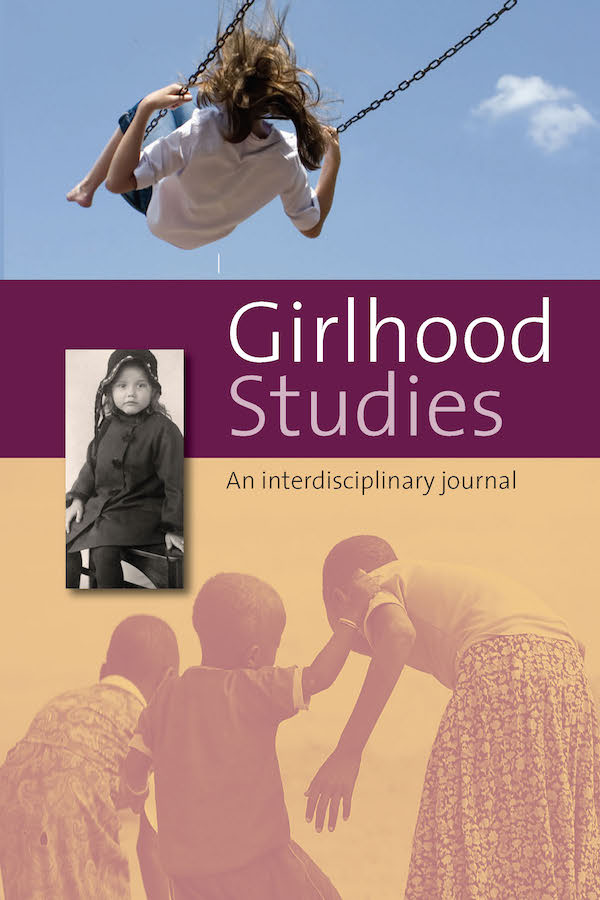
Girlhood Studies
An Interdisciplinary Journal
ISSN: 1938-8209 (print) • ISSN: 1938-8322 (online) • 3 issues per year
Volume 16 Issue 1
Reframing African Girlhood
This Special Issue on African Girlhoods is long overdue for many reasons, not least of which is its recognition, as guest editors Marla L. Jaksch, Catherine Cymone Fourshey, and Relebohile Moletsane point out, of the somewhat vexed history of the discourse of the African girl-child that dates back to the global development literature of the early 1990s attached to the Fourth World Conference on Women: Action for Equality, Development and Peace, held in Beijing in September, 1995—typically referred to just as Beijing. This, and the many country and regional conferences leading up it were (and still are) game-changers in so many ways when it comes to the lives of girls and women. It would be remiss of me not to acknowledge that I participated readily in the early days of defining the girl-child when I was working as a short-term UNICEF consultant in Zambia to develop an agenda for the Ministry of Education and other policy actors for research about education for girls in Zambia. One of the events in which I participated in Lusaka in October 1994 as part of my fact-finding and local consulting was a meeting of 80 or more local NGO members and other Zambian women who were planning their submissions to the November 1994 African Platform for Action: Fifth African Regional Conference (Dakar) on Women preparatory to Beijing. As an observer at this meeting, I heard a presenter talk about the fact that she was one of the first women (if not
A Turn to the African Girl
Over the last century, girls in Africa, long ignored as sources of knowledge, have, nevertheless, engaged vocally and publicly in activism and artistic endeavors to express their visions and aspirations for a future society inclusive of their needs. Only recently have scholars begun to examine the complicated nature of girlhood in relation to capacity, competence, and knowledge layered with vulnerability and inexperience. In the last decade, the flourishing of girls’ inventive acts of agency and their use of their own incisive voices have given impetus to the growing scholarship on girls’ vibrant historical and current political, economic, creative, and cultural pursuits.
As Knowers and Narrators
A Case Study of African Girlhood
Expanded feminist narratives on the girl child have paid little attention to how young girls have become agents of their own change and sharers of their own knowledge. In this study, we spotlight girls’ agency reinforced by institutions that transform them from recipient to agents of change and resilience. In this qualitative study, we deploy critical analysis and reflective argumentation to underscore how Women's Research and Documentation Center (WORDOC) of the Institute of African Studies University of Ibadan provided Do-It-Yourself (DIY) tactics to girls aged 10 to 18 between 2018 and 2019 at its annual WORDOC Girls’ Summit. We explore a version of African girlhood aimed at presenting institutional impacts that offer platforms for girls’ self-empowerment and girl-agency in Nigeria.
Young Mothers as Peer Researchers in a Collaborative Study
In this article, I draw on experiences of a collaborative ethnographic study conducted with young mothers as peer researchers in a poor urban locale in Kampala-Uganda. Young motherhood has been researched
“Let's Go to School and Marry Later”
Tanzanian Girls’ Schooling (1939–1976)
In this article, I track the contribution of Tanganyikan girls to the big push for schooling that characterized the country, and the whole of Africa, from the 1940s to the late 1970s. So doing, I bring together two historiographies—works that document nationalist discourses that promoted this quick expansion of the schooling system and those that underline the agency of African girls in shaping their lives and education. Reading together girls’ writings in the press, archival documentation, and interviews with adult women, I propose a nuanced analysis of girls’ stances towards a public discourse that made their schooling a significant asset for nation-building.
Ndebele Girls as Knowers
Menstrual Preparation and Sanitary Preferences in Zimbabwe
In this article, I examine critically the framing of the African girl child in international development discourse on menstruation and menstrual activism and address the question, “What influence have African girls had on policy or programs and to what extent have they been mere targets and objects of such policies and programs?” I analyze baseline interviews I carried out at the inception of a Zimbabwean sanitary wear intervention and shine a light on African girls as potential guides and consultants in constructing policy and programs. I show how the communitarian,
“I Fall Pregnant!”
Unequal Bodies in South African Higher Education
Girls from single-parent households in South Africa (90 percent of whom are Black African or coloured) have significantly lower educational outcomes than other demographics. Through a methodology of life-history interviews, we explore the experiences of 30 women in single-headed households who have been successful in their educational endeavours as university students or graduates. Results show that pressures on girls from single-headed households to look after the family and domestic sphere and to protect their bodies from sexual abuse leave many girls depleted of the time, energy, and mental capacity required to study. Despite these challenges, these participants have escaped the perceived weight of their female burden in a post-apartheid, patriarchal society and reclaim their bodies and sense of agency through educational success.
Cameroon's Schools
Sites of Sexual, Physical, and Psychological Violence Against Girls
In this article, the data for which I acquired through a systematic review of articles published over three years, focusing on analyzing the evolution of the situation over these past years, I discuss school-based gender violence in Cameroon. Considering the complexity of Cameroonian society and its responses to violence against girls and women, we need to establish that violence can be addressed, and we have to suggest how this can be done. From one region to another, a girl being denied access to education, being trafficked, or being forced into early marriage constitutes an experience of violence. Even though the government has been fighting these ills for the past twenty years the results show that girls are still highly vulnerable in the education system.
South African Rural Girls’ Safety Strategies on the School Journey
In this article, we use data generated through photovoice and focus group discussions to examine how primary school girls from two resource-poor and high-risk rural communities in KwaZulu-Natal, South Africa, negotiate their safety on the dangerous journey to and from school. Our findings show that girls actively identify and apply specific safe-seeking strategies by drawing on available community and interpersonal resources as they navigate their way to school. These strategies moderate risk exposure and are perceived to reduce girls’ vulnerability to victimization. While the sustainability of these strategies remains in question, it is essential to note that girls can exercise their agency in providing safety in sociocultural and geographic contexts that expose them to risk.
Odes to African Girlhood
i am a child of stories. i live in stories. stories carried by the water and told by the drums.
A Letter to my Daughter
based on
Preciousness and Precarity
The Black Girl on My Shoulders
DaMaris Hill. 2022.