 Get New Issue Alerts
Browse Archive
- Vol 19 Issue 2
- Vol 19 Issue 1
- Vol 18 Issue 3
- Vol 18 Issue 2
- Vol 18 Issue 1
- Vol 17 Issue 3
- Vol 17 Issue 2
- Vol 17 Issue 1
- Vol 16 Issue 3
- Vol 16 Issue 2
- Vol 16 Issue 1
- Vol 15 Issue 3
- Vol 15 Issue 2
- Vol 15 Issue 1
- Vol 14 Issue 3
- Vol 14 Issue 2
- Vol 14 Issue 1
- Vol 13 Issue 3
- Vol 13 Issue 2
- Vol 13 Issue 1
- Vol 12 Issue 3
- Vol 12 Issue 2
- Vol 12 Issue 1
- Vol 11 Issue 3
- Vol 11 Issue 2
- Vol 11 Issue 1
- Vol 10 Issue 3
- Vol 10 Issue 2
- Vol 10 Issue 1
- Vol 9 Issue 3
- Vol 9 Issue 2
- Vol 9 Issue 1
- Vol 8 Issue 3
- Vol 8 Issue 2
- Vol 8 Issue 1
- Vol 7 Issue 2
- Vol 7 Issue 1
- Vol 6 Issue 2
- Vol 6 Issue 1
- Vol 5 Issue 2
- Vol 5 Issue 1
- Vol 4 Issue 2
- Vol 4 Issue 1
- Vol 3 Issue 2
- Vol 3 Issue 1
- Vol 2 Issue 2
- Vol 2 Issue 1
- Vol 1 Issue 2
- Vol 1 Issue 1
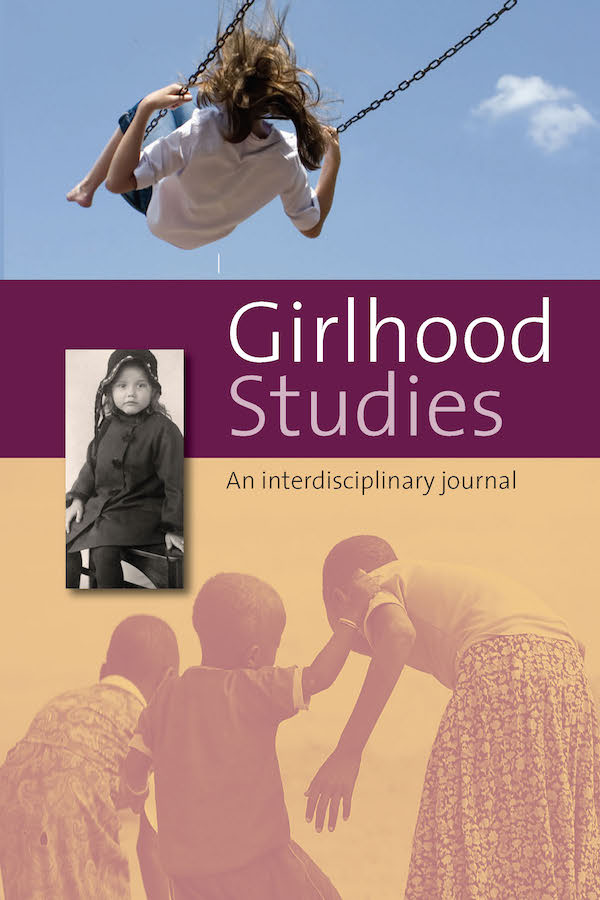
Girlhood Studies
An Interdisciplinary Journal
ISSN: 1938-8209 (print) • ISSN: 1938-8322 (online) • 3 issues per year
Volume 4 Issue 2
Girls and their Health
It has been forty years since the feminist classic on women’s health and sexuality, Our Bodies, Our Selves was published. Available first in 1971 and then produced commercially in 1973 (revised, re-issued and, as of October 2011, in its ninth printing), Our Bodies, Our Selves, published by the Boston Women’s Collective, was regarded by many girls and women in the 1970s and 1980s as the book that changed their relationship to their own bodies and to their own health. And indeed, it set the stage for a revisioning of the questions: “Whose bodies?” and “Whose voices?” in health research, and could be regarded as a precursor to such works as Sandra Harding’s (1991) Whose Science? Whose Knowledge? Thinking from Women’s Lives.
Health is Sexy for Girls
In the call for articles for this special issue on girls’ health, we highlighted that “[g]irls’ health is an ongoing and evolving issue with ties that go beyond medical analyses to include a wide array of social, educational, political, and environmental discourses (among others!).” Th at a number of different perspectives might contribute to or strengthen the interdisciplinary focus of an issue as crucial as girls’ health was important to me as guest editor. Th is issue demonstrates that the relationship of girlhood to health—sexual health, in particular—is of critical concern to us all. It is an area full of challenges and barriers, most of them, as is evident in this issue, understood and often expressed by girls themselves. The articles presented here point to the many perspectives from which to approach this topic. Girls’ sexual health is linked to an array of intersecting issues including the pedagogical influences of popular romance literature; the ways in which girls use blogs to construct counter narratives about their sexual identity; how girls’ increased inclusion in citizenship discourses can increase their capacity to address sexual objectification; what girls do to negotiate power within their heterosexual relationships; how barriers to water access in Africa can lead to the awareness of the risks—which range from being perceived to be promiscuous to being raped—that young women face; as well as how the (mis)management of menstruation can affect girls’ education. This issue points to the global and local specifics of sexual health, and to health more generally. Th e concerns discussed here are geographically wide-ranging: Cameroon, Lesotho, Australia, the United States, and Canada provide the settings—some urban and others rural. Th e authors present a wide range of methodologies from which they explore girls’ health: literary analysis; autoethnography; and participatory methods such as digital storytelling, mediamaking, listening to what young people have to say in various research paradigms, blogging, and photovoice.
Erotic Capital, Popular Pedagogy, and Healthy Adolescent Female Sexuality
The sexualization of the female body in contemporary media has created considerable anxiety about its impact on girls. Much of the resulting research focuses on the influence of visual media on body image and the flow-on effects for girls' health. Rather less attention is paid to the pedagogical role of popular romance fiction in teaching girls about their sexuality. Given the pronounced increase in eroticized fiction for girls over the past decade, this is a significant oversight. This article applies Hakim's (2010) concept of erotic capital to two chick lit novels for girls. The elements of erotic capital—assets additional to economic, cultural and social capital—are used to explore the lessons these novels teach about girl sexual subjectivities and sociality in a sexualized culture.
Girls in the World
Digital Storytelling as a Feminist Public Health Approach
Strategies designed to address community health needs, and those of disadvantaged girls in particular, are more likely to be successful in supporting health and wellbeing if a humanistic perspective is taken. A humanistic health perspective should consider broader participant concerns, including those that are socially informed. A feminist perspective on knowledge production and a corresponding narrative approach—digital storytelling—has the potential for doing so in the field of community health and in social research efforts. We begin by reviewing a feminist perspective on knowledge development and present digital storytelling as an approach undergirded by this perspective. We then present examples of two digital stories produced by adolescent girls during a pilot community-based participatory project called A Girl in the World which focused on what it actually means to be girls in the world, and conclude that digital storytelling has the potential to provide a more holistic research platform for investigating girls' health.
We're Taking Back Sexy
Girl Bloggers SPARK a Movement and Create Enabling Conditions for Healthy Sexuality
SPARK, Sexualization Protest Action Resistance Knowledge, is an intergenerational movement that raises awareness about, and pushes back against, the sexualization of women and girls in the media to create room for whole girls. In this article, I document the ways in which the SPARKTeam, a diverse collection of young feminist bloggers, contributes to the creation of conditions that enable healthy sexuality by using their blogs to reclaim what it means to be sexy, and to invite creative forms of resistance to media sexualization.
Getting Girls and Teens into the Vocabularies of Citizenship
This article addresses the invisibility of teenage girls within and outside of feminist theory and citizenship studies from the perspective of girlhood studies. Most often addressed as individuals in need of protection, girls and adolescent females are seldom considered political citizen-subjects. In addition, because they do not fit within existing frameworks of analysis, some of their citizenship practices, including mediamaking, are not acknowledged as forms of political agentivity or political participation. Drawing on my past and current research with Francophone teenage girls in Canada, I highlight and problematize this denial in a way that underlines the need for girlhood studies to politicize its vocabulary so that teenage girls can become part of us rather than women-to-become in feminist citizenship studies and others areas of inquiry in which youth citizenship is being re-theorized. I argue that such politicization broadens what girls' health entails to include their political healthiness.
Subject, Object, or Both? Defi ning the Boundaries of Girl Power
Issues related to young women, power and sex are central to feminism and remain a central source of debate. This centrality underscores the need to question what power and sex mean to young women. Research that weaves together lessons from feminism and from young women's own lived experiences can advance our understanding of young women, power and sex. This article describes how a sample of young women define, understand and conceptualize their power within their heterosexual relationships. The young women's words provide insight into how current feminist understandings of girl power may need to be reconsidered and adapted to explain young women's changing realities.
Fetching Water in the Unholy Hours of the Night
The Impacts of a Water Crisis on Girls' Sexual Health in Semi-urban Cameroon
In sub-Saharan Africa, girls' daily household chores often involve fetching water for their households. This article addresses the impact of uncertain water access in semi-urban Cameroon given the problems of rapid urbanization and increasing demands for water. A school competition engaged youth and key water sector actors in a dialogue about the water crisis in Buea town, and this resulted in the publication of the water distribution schedule. The event also drew attention to the gendered implications of the crisis in relation to girls' sexual health. Our analysis suggests that girls fetching water face multiple layers of risk that include gender-based violence and blame resulting from the gendered stigma attached to young people's behavior—particularly that of girls. All this serves to increase the moral panic surrounding youth sexualities. We explicitly use the term sexualities (plural) here to recognize the multiple ways in which sexualities may be expressed, constructed and experienced (Arnfred 2005). This research points to the dire need to better understand and consider within water management strategies how girls cope with and confront these risks.
Growing Up a Girl in a Developing Country
Challenges for the Female Body in Education
Girls' reproductive health matters are an important factor in their equal participation in educational settings. However, many girls worldwide still face challenges to participating fully in education because of the lack of supportive structures for their health needs. This paper uses autoethnographic writing to highlight some of the challenges that girls meet in school because of menstruation. It also discusses how a teacher's lived experiences of girlhood can change how she practises her teacher-hood in relation to girls' reproductive health. I argue that teachers' lived experiences are an invaluable resource in curricula- and policy-making procedures that are formulated to better recognize the particular concerns of girls and young women.
Let's Talk About Sex
Photo Gallery
Arts-based approaches have been used to engage youth in health promotion activism and research in both local and international contexts. The application of art to research as a mode of inquiry has been a means of actively engaging marginalized communities such as youth in the research process in a way that allows them to creatively represent their thoughts and lives, while negotiating their power within the research environment (Wright et al. 2010). In representing their lived experiences, youth are able to name their worlds and challenge dominant culture (including the ways the media represents them) and its inherent power relations (Barndt 2008; Bagnoli 2009). Using art to do this becomes a catalyst for diff erent kinds of knowledge and knowing (Barndt 2008).
The Power of Mean
Nicole Landry. 2008. The Mean Girl Motive: Negotiating Power and Femininity. Halifax: Fernwood Books.
Honouring the Traditional and the Modern in South Africa
J. L. Powers. 2011. This Thing Called the Future. El Paso, TX: Cinco Puntos Press.