 Get New Issue Alerts
Browse Archive
- Vol 19 Issue 2
- Vol 19 Issue 1
- Vol 18 Issue 3
- Vol 18 Issue 2
- Vol 18 Issue 1
- Vol 17 Issue 3
- Vol 17 Issue 2
- Vol 17 Issue 1
- Vol 16 Issue 3
- Vol 16 Issue 2
- Vol 16 Issue 1
- Vol 15 Issue 3
- Vol 15 Issue 2
- Vol 15 Issue 1
- Vol 14 Issue 3
- Vol 14 Issue 2
- Vol 14 Issue 1
- Vol 13 Issue 3
- Vol 13 Issue 2
- Vol 13 Issue 1
- Vol 12 Issue 3
- Vol 12 Issue 2
- Vol 12 Issue 1
- Vol 11 Issue 3
- Vol 11 Issue 2
- Vol 11 Issue 1
- Vol 10 Issue 3
- Vol 10 Issue 2
- Vol 10 Issue 1
- Vol 9 Issue 3
- Vol 9 Issue 2
- Vol 9 Issue 1
- Vol 8 Issue 3
- Vol 8 Issue 2
- Vol 8 Issue 1
- Vol 7 Issue 2
- Vol 7 Issue 1
- Vol 6 Issue 2
- Vol 6 Issue 1
- Vol 5 Issue 2
- Vol 5 Issue 1
- Vol 4 Issue 2
- Vol 4 Issue 1
- Vol 3 Issue 2
- Vol 3 Issue 1
- Vol 2 Issue 2
- Vol 2 Issue 1
- Vol 1 Issue 2
- Vol 1 Issue 1
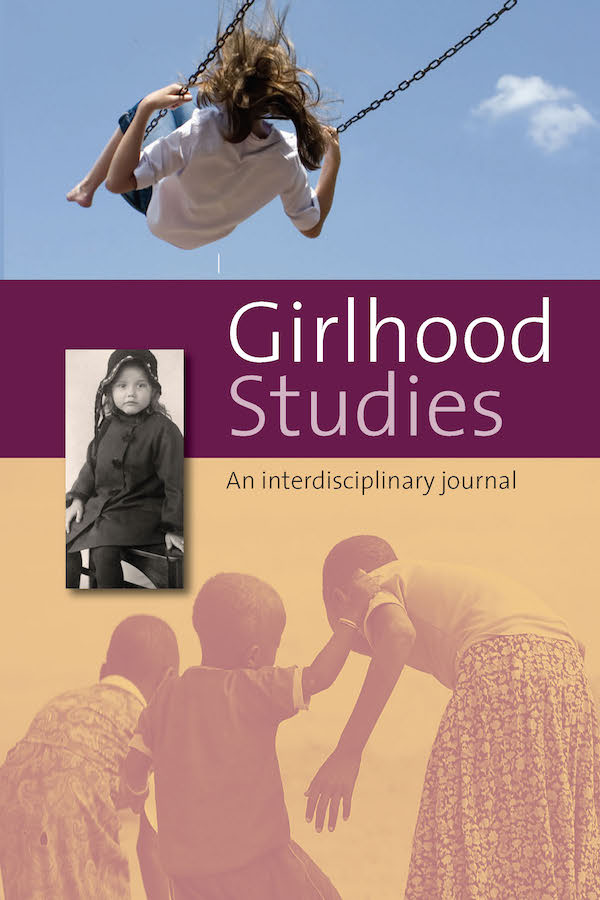
Girlhood Studies
An Interdisciplinary Journal
ISSN: 1938-8209 (print) • ISSN: 1938-8322 (online) • 3 issues per year
Volume 6 Issue 2
Nordic Girls' Studies
Current Themes and Theoretical Approaches
This special issue of Girlhood Studies is the first one to have been devoted to the study of girls living in a specific geographical region. Here we focus on girls in the Nordic countries. What makes this set of essays particularly fascinating is that they address issues concerning girls who are located in countries whose advanced social services and democratic beliefs and practices are admired around the world. The rest of the world believes that the Nordic countries, Sweden, Iceland, Norway, Finland and Denmark, have achieved much of what girls in other countries in both the Global North and Global South are still working and fighting for. Interestingly, in their call for papers the guest editors Bodil Formark and Annelie Bränström Öhman, both located at Umeå University in Sweden, cite Finish sociologist Elina Oinas (2011) who queries whether Nordic girls do in fact belong to that exclusive group of “girls who won the lottery.” In the articles in this issue, the contributors interrogate some of the assumptions the rest of the world makes about the lives of girls living in Nordic countries, and the different notions of freedom that have an impact on them.
Situating Nordic Girls' Studies
While we have been working on this themed issue the political talk about The Girl has entered a new phase in a global shift manifested both by the establishment of the International Day of the Girl and through the launching of various campaigns on themes such as: Give Girls an Education and Eradicate World Poverty. The necessity for such initiatives was cruelly illustrated by the violent attack on Pakistani girls’ rights activist Malala Yousafzai on her way home from school on 9 October 2012. Such blatant discrimination makes it difficult for us not to feel that we live in a privileged part of the world. The five Nordic nation states—Denmark, Finland, Iceland, Norway and Sweden—are indeed often perceived by outsiders, too, as progressive countries that have come very far in achieving gender equality. However, although Nordic girlhood may appear in stark contrast to that of the millions of disadvantaged girls in the world, there are complexities and ambivalences beneath the surface of Nordic progressiveness that a reductive, comparative, and linear, framework fails to take into account.
A Music Room of One's Own
Discursive Constructions of Girls-only Spaces for Learning Popular Music
This article elaborates on discursive constructions of girls-only settings through the spatial metaphor of a room of one's own, as articulated in round-table discussions among staff and participants from girl-centered music programs in Sweden. The idea of a separate room refers to spaces for collective female empowerment as well as for individual knowledge acquisition and creativity. These spaces are constructed so as to provide the possibility for exploration, subjectivity, and focus, by offering (partial and temporary) escape from competition and control, from a gendered and gendering gaze, and from distraction. Girl-centered programs are also discussed as paradoxical because they function as gender-neutral when seen from the inside, but gender-specific when seen from the outside.
Sexy Shapes
Girls Negotiating Gender through Popular Music
This article is based on ethnographic fieldwork done with a group of 14 to 16 year-old girls in a medium sized Swedish town. The study aimed to investigate the relationship between everyday music use and gender, ethnicity and sexuality. The question posed here is: "What negotiations take place when the girls discuss their favorite music and artists?" Research in response to this question shows that the identity work of negotiating how to be a teenage girl often relates to popular culture. The sample focuses on girls from Swedish, Bosnian, Turkish and Syrian backgrounds. In this article I report on the local ideas about gender and ethnicity claimed by the girls to influence their discussion of music, dress and behavior, as well as the desires that I argue structure such discussion. This research supports contemporary findings that mainstream popular music has cultural and social significance in young girls' lives.
"Save the Girls!" Gender Equality and Multiculturalism in Finnish Youth Work Contexts
This article examines multiculturalism and gender equality in the light of ethnicity, gender, and agency so as to illustrate how gender equality is used as a marker of Finnishness in various youth work contexts. The data presented consists of interviews with youth workers (n=42) and ethnographic fieldwork carried out from 2003 to 2005. The results illustrate that questions related to multiculturalism have enhanced the visibility of gender equality in youth work. The identification of gender-based inequality is connected, in particular, to girls from migrant backgrounds whose education and well-being are of social concern. Youth work itself is often seen as gender-neutral and equality-based. However, this illusion of gender equality reflects more the ideals of equality which are not being concretized in the practices of youth work. Equality in this context is defined as a purely quantitative concept: the solution to any possible inequalities is, therefore, that everyone should be treated in the same way.
"Superficial! Body Obsessed! Commercial!" Norwegian Press Representations of Girl Bloggers
Teenage female personal bloggers in Norway occupy the top positions in national blog rankings. This takes girl-bloggers to a place where they have rarely, if ever, been before: a place with massive audiences and media attention that can bring about celebrity status or financial benefits. Operating within a genre of personal blogging that combines accounts of everyday life and topics related to fashion and beauty, they are commonly referred to as pink bloggers. This gendered term is widely used in the media and this article argues that it contributes to a reinforcement of a negative image of teenage female personal bloggers, who are dismissed as trivial, commercial and irresponsible. This article analyzes prevailing discursive representations of the so-called pink bloggers in the mainstream press coverage: popular but insignificant, trendsetting but irresponsible, savvy but vulnerable. The implications of these representations are discussed as well.
"What Do Eva and Anna Have to Do with Cervical Cancer?" Constructing Adolescent Girl Subjectivities in Swedish Gardasil Advertisements
This article investigates direct-to-consumer advertising in Sweden for Gardasil, the HPV vaccine, as a contemporary gendered technology of the adolescent girl body. It explores how, by constructing girls as ideal users of the vaccine, advertising campaigns encourage adolescent girls to vaccinate themselves. Using a feminist visual discourse analysis, the article examines how different girl subjectivities are constructed through advertising, and presented as fit for Gardasil use and consumption. It highlights how, along with their parents, adolescent girls in Sweden are encouraged to assume responsibility for managing the risks of cervical cancer in order to help secure their future health, sexuality and normality. It argues that the Gardasil campaign, in being addressed to individual members of the population, serves to articulate global and national discourses of girlhood, sexuality, (sexual) health responsibility, risk management and consumption.
Becoming Healthy, Free and Physically Active
Medical Discourse on Girls in Sweden c. 1880-1930
The sick girl was a popular stereotype in Swedish medical discourse around 1900. It was established by medical authorities at the time that a substantial number of Swedish girls suffered from various diseases and ailments. However, at the beginning of the twentieth century, at a time when the welfare state was gradually evolving in the Nordic countries, the scientific opinion of girls changed. The new girl was represented as healthy and active. This article examines the medical discourse on girls, and their activity and health in Sweden during circa 1880 to 1930. It reveals patterns of the medicalization of girls as well as categorizations and constructions of girlhood that corresponded with contemporaneous notions of gender. It reveals a recurring, if inconstant, problematization of girls' illness and lack of adequate physical activity. In this article I will show how the discussions about girls around 1900 share several similarities with current ones.
Light, Love and Desire
The New Wave of Finnish Girls' Literature
This article examines four works of contemporary Finnish girls' literature. The main focus is on the analysis of various aspects of sexuality represented in the novels in relation to these two questions: How do they depict adolescent female sexuality in comparison to the generic conventions and the history of girls' literature? Do the representations expand, change, preserve and/or challenge the genre? The noticeable change is that the desire and love depicted in contemporary Finnish girls' literature can be lesbian and bisexual. However, although these representations of sexuality challenge some generic limits, the genre characteristics of girls' literature seem to have remained relatively unchanged.
An Eccentric Parade of Light Red Girls
Maria Margareta Österholm. 2012. Ett flicklaboratorium i valda bitar: Skeva flickor i svenskspråkig prosa från 1980-2005 [A girl laboratory in chosen parts: Skeva girls in Swedish and Finland Swedish literature from 1980 to 2005]. Stockholm: Rosenlarv Förlag.
A Guide to Finnish Girls' Studies
Karoliina Ojanen, Heta Mulari, and Sanna Aaltonen, eds. 2011. Entäs tytöt: Johdatus tyttötutkimukseen [But what about girls: Introduction to girls’ studies]. Nuorisotutkimusverkosto/Nuorisotutkimusseura, julkaisuja 113. Tampere: Vastapaino.
Thinking About Pink
Fanny Ambjörnsson. 2011. Rosa: Den farliga färgen [Pink: The dangerous color]. Stockholm: Ordfront Förlag.