 Get New Issue Alerts
Browse Archive
- Vol 19 Issue 2
- Vol 19 Issue 1
- Vol 18 Issue 3
- Vol 18 Issue 2
- Vol 18 Issue 1
- Vol 17 Issue 3
- Vol 17 Issue 2
- Vol 17 Issue 1
- Vol 16 Issue 3
- Vol 16 Issue 2
- Vol 16 Issue 1
- Vol 15 Issue 3
- Vol 15 Issue 2
- Vol 15 Issue 1
- Vol 14 Issue 3
- Vol 14 Issue 2
- Vol 14 Issue 1
- Vol 13 Issue 3
- Vol 13 Issue 2
- Vol 13 Issue 1
- Vol 12 Issue 3
- Vol 12 Issue 2
- Vol 12 Issue 1
- Vol 11 Issue 3
- Vol 11 Issue 2
- Vol 11 Issue 1
- Vol 10 Issue 3
- Vol 10 Issue 2
- Vol 10 Issue 1
- Vol 9 Issue 3
- Vol 9 Issue 2
- Vol 9 Issue 1
- Vol 8 Issue 3
- Vol 8 Issue 2
- Vol 8 Issue 1
- Vol 7 Issue 2
- Vol 7 Issue 1
- Vol 6 Issue 2
- Vol 6 Issue 1
- Vol 5 Issue 2
- Vol 5 Issue 1
- Vol 4 Issue 2
- Vol 4 Issue 1
- Vol 3 Issue 2
- Vol 3 Issue 1
- Vol 2 Issue 2
- Vol 2 Issue 1
- Vol 1 Issue 2
- Vol 1 Issue 1
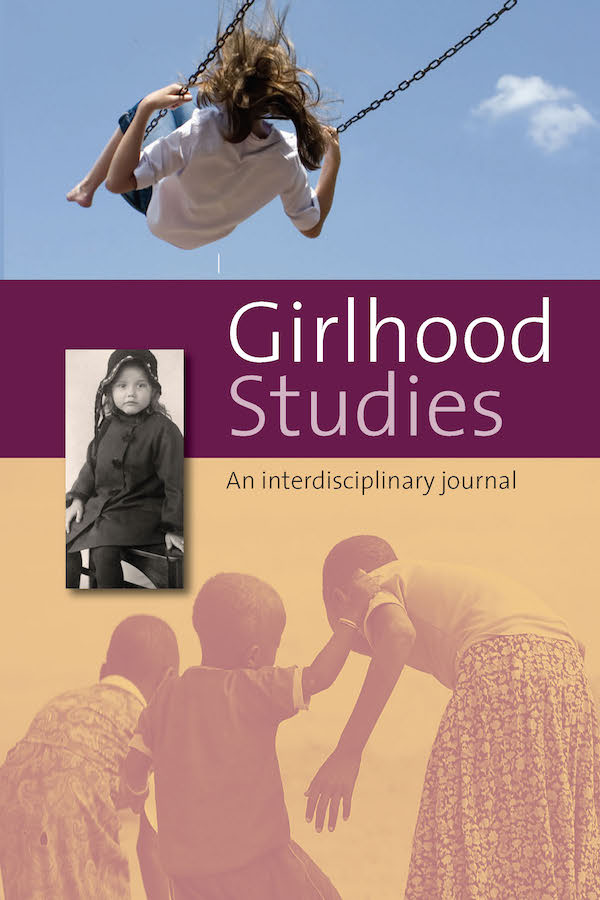
Girlhood Studies
An Interdisciplinary Journal
ISSN: 1938-8209 (print) • ISSN: 1938-8322 (online) • 3 issues per year
Volume 15 Issue 2
Contesting
This issue of
Witnessing Public Mourning in Haudenosaunee Youth Theatre
While the Indigenous youth suicide crisis in Canada is widely acknowledged, there is little scholarly attention given to writers who reflect on this from the perspective of being suicide survivors. In this article, I consider the play,
Precarious Girls and (Cruel) Optimism
Protecting Sexually Abused Teenage Girls
Using data collected as part of a larger qualitative study, I attend to the presence of two seemingly opposing narratives shaped by neoliberal and postfeminist attitudes—a gloomy one in which girls are thought to be at risk of experiencing poor life outcomes and an optimistic one that claims ubiquitous opportunity for all girls regardless of circumstance or experience. I suggest that both narratives combine to contribute to girls’ responsibilization for their future successes (and failures). I consider the potential cruelty of optimistic child protection practices grounded in a fantasy of future success as self-determined and accessible to those sexually abused teenage girls willing to work hard.
When Girls Lead
Changing the Playbook for Climate Justice
Greta Thunberg's prominence in the climate justice movement symbolically positions girls at the epicenter of geopolitical resistance, but, while she is given immediate authority across media outlets, other girls’ visions of a more equitable future are often disregarded; this demands our careful attention. We discuss the work of five New York City-based girl activists of color engaged in this movement. We explore the ways in which their intersectional identities and social positions shape their mobilization strategies and draw connections to other popular social justice movements; their activist playbook reveals the transformative potential of intersectional feminist politics in the hands of Generation Z. These girl activists of color generate sophisticated, relational platforms for climate justice informed by the interconnected issues of racial and economic injustice.
“Honestly, Anywhere that I Have Wi-Fi”
A Posthuman Approach to Young Women's Activist Blogging
We add to the scholarship on young women's online activism using a Baradian framework to explore the material-discursive contexts that co-create the meanings and possibilities of their activism. Through a diffractive methodology, we delve into key moments from blogs and interviews with bloggers to discuss two emerging themes. First, we offer an understanding of activist girl blogger subjectivities as intra-actively embedded and remade in material-discursive contexts of girlhood, artist, and celebrity in a neoliberal digital culture that valorizes social media influencers. Second, we examine the related entanglements of discourses-materialities-time-space-bodies, and the human and non-human agencies that co-constitute young women's activist blogging. Overall, we illustrate the potential of a Baradian approach for understanding the human and more-than-human complexities of young women's activist blogging and activist subjectivities.
(Un)romantic Becomings
Girls, Sexuality-assemblages, and the School Ball
Popular culture and media often portray school balls and proms as romantic spaces and having a date is perceived as the norm. While gender(ed) and heterosexual discourses continue to shape young people's experiences, girls’ understandings of the school ball do not necessarily conform to dominant ideas. In this article, I draw on a new materialist ontology of sexuality to explore the relations in-between girls, dates, and the school ball. I examine ball-girl-date encounters as sexuality-assemblages comprising bodies, spatial-material arrangements, practices, and imaginings. In this frame, sexuality is conceptualized as becoming via an array of material-discursive, human, and more-than-human forces. I consider how ball-girl capacities and desires become emergent and contingent, opening up ways of thinking about girls and the school ball beyond popular cultural constructions.
Intergenerational Writing Practices in Chinese Fiction for Adolescent Girls
Doing the Fairy Tale Quest
Contesting the Author in the Video Game
Despite the encouragement of women's and girls’ curiosity in matriarchal and oral fairy tale traditions, their patriarchal print production in Western Europe reframed this trait as undesirable. Fairy tale print productions also troubled the tales’ transformative and communal form in establishing versions that would receive ongoing duplication by attaching prominent authorial figures. In this article, I investigate the teen girl detective game as a format that reflects upon and updates these values. Taking Mografi's
Girl Athletes in Ethiopia Finding Voice Empowerment Through Sport
Since sport extends well beyond the routine of practice and competition and leads to the development of skills that affect other areas of life, my study explored whether girl athletes experience greater voice empowerment as a result of playing sport. The term voice empowerment is unique to traditional leadership and character programming; it emerged from recent scholarship in the fields of education, sport, and psychology. In this study, 30 Ethiopian girl athletes aged 13 to 18 completed a 24-item questionnaire that focused on the constructs of sport, voice, and gender equity. My findings suggest that sport along with emotional and academic support, coupled with an effective life skills program, does affect voice empowerment.
Imagining the Girl Effect
An Ethnography of Corporate Social Responsibility
Kathryn Moeller. 2018.