 Get New Issue Alerts
Browse Archive
- Vol 19 Issue 2
- Vol 19 Issue 1
- Vol 18 Issue 3
- Vol 18 Issue 2
- Vol 18 Issue 1
- Vol 17 Issue 3
- Vol 17 Issue 2
- Vol 17 Issue 1
- Vol 16 Issue 3
- Vol 16 Issue 2
- Vol 16 Issue 1
- Vol 15 Issue 3
- Vol 15 Issue 2
- Vol 15 Issue 1
- Vol 14 Issue 3
- Vol 14 Issue 2
- Vol 14 Issue 1
- Vol 13 Issue 3
- Vol 13 Issue 2
- Vol 13 Issue 1
- Vol 12 Issue 3
- Vol 12 Issue 2
- Vol 12 Issue 1
- Vol 11 Issue 3
- Vol 11 Issue 2
- Vol 11 Issue 1
- Vol 10 Issue 3
- Vol 10 Issue 2
- Vol 10 Issue 1
- Vol 9 Issue 3
- Vol 9 Issue 2
- Vol 9 Issue 1
- Vol 8 Issue 3
- Vol 8 Issue 2
- Vol 8 Issue 1
- Vol 7 Issue 2
- Vol 7 Issue 1
- Vol 6 Issue 2
- Vol 6 Issue 1
- Vol 5 Issue 2
- Vol 5 Issue 1
- Vol 4 Issue 2
- Vol 4 Issue 1
- Vol 3 Issue 2
- Vol 3 Issue 1
- Vol 2 Issue 2
- Vol 2 Issue 1
- Vol 1 Issue 2
- Vol 1 Issue 1
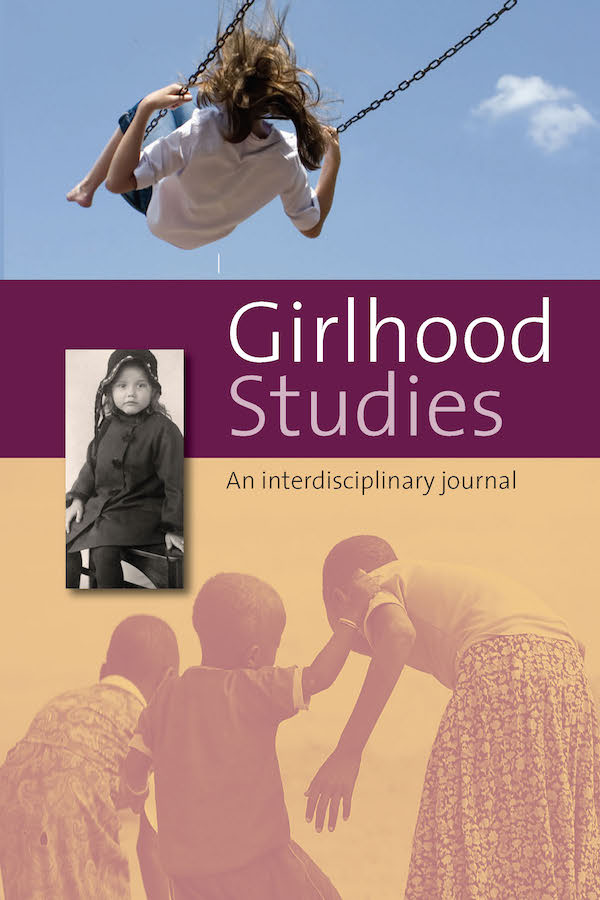
Girlhood Studies
An Interdisciplinary Journal
ISSN: 1938-8209 (print) • ISSN: 1938-8322 (online) • 3 issues per year
Volume 2 Issue 1
Girlhood practices
This issue of Girlhood Studies focuses on particular girlhood practices—the everyday activities in which some girls engage as part of their ordinary lives. In this issue we look at these girls engaging in these practices, sometimes on their own and sometimes in small groups, how and when they engage in them and where they do so. These include the long-standing practice of girls engaging in child care as babysitters, playing with dolls (in the case of younger girls) or reading fashion magazines (in the case of older girls). These activities take place in different locations, some of which have been associated historically with girlhood, such as a girl’s bedroom or a school classroom, and others which have been more recently appropriated by girls as congenial spaces, such as shopping malls, movie theaters and the internet.
Mean, Wild, and Alienated
Girls and the State of Feminism in Popular Culture
The article explores representations of "realistic" teen girlhood in popular culture in order to examine the current constructions of power made available to girls. Specifically, it focuses on three recent popular and critically acclaimed films: Mean Girls, Thirteen and Ghost World. The dominant discourses put forward in these films—girls as mean, as wild, and as alienated—naturalize negative behavior as a normal part of girlhood. In the terrain where these distinct, yet overlapping and reinforcing discourses on girlhood operate, postfeminism is taken for granted. Girls are portrayed as facing only individual concerns rather than any group-based injustices and, therefore, as not needing collective deliberation, evaluation, or action to solve their problems. The resulting discursive formation works to limit access to feminist and other oppositional discourses that name girls' experiences and link their feelings to the ongoing quest for gender justice.
Femininity Out of Control on the Internet
A Critical Analysis of Media Representations of Gender, Youth, and MySpace.com in International News Discourses
This article raises issues related to the gendered representation in the print media, particularly English-language newspapers, of girls who use MySpace as foolish innocents who invite sexual predation. It examines the ways in which the stereotyped representation of girls and boys promotes the hegemonic discourses that construct girlhood as a time of helplessness and lack of control, and that blame the technology itself, in this case MySpace, for a multitude of cultural problems. Ultimately, these discourses portray MySpace as a dangerous place where adolescent girls flaunt sexuality, where sexual predators lurk, and where boys commit violence, thus creating and reinforcing a moral panic and extending stereotypes about girls and boys, and about technology.
"i HATE HATE HATE being single" and "why is getting a bf so hard for me?"
Reproducing heteronormative femininity on gURL.com
This article examines the prominent romantic and sexual scripts—the most common being that of a "prince charming" waiting for a girl—found on the "being single" message board of gURL.com. A discourse and textual analysis of the message board is conducted in order to analyze how girls are performing their (hetero)sexual identities. This provides insight into current notions of contemporary girlhood and romantic/sexual expectations. Findings suggest that girls believe that being single is "caused" by something—most often that a girl is not pretty enough or not outgoing enough—so singledom is "blamed" on a lack of (appropriate) femininity. Also, if a girl fails at femininity then it is assumed that she might also be failing at heterosexuality. Girls seem to believe that by becoming more conventionally feminine (outgoing and attractive), singledom can be "fixed" and thus heteronormativity and femininity are reaffirmed.
Reclaiming Feminism
A Qualitative Investigation of Language Usage by Girls in a High School Women's Studies Course
This article examines the impact of women's studies on at-risk high school girls. This analysis was conducted within a larger intervention study examining the effect of women's studies on levels of sexual harassment within the school. As a teacher researcher, I observed that students were embracing terms traditionally degrading to women so I then began to study the language usage of the students in the course as a separate study. I assessed changes in the language usage of students and observed the evolution of their language. It became, as the course progressed, more egalitarian and em powered as they embraced feminist principles.
Living in a hybrid material world
Girls, ethnicity and mediated doll products
Drawing on a theoretical framework that combines Media Studies, Latina/o Studies, and Girls Studies with the concept of hybridity, I explore American Girl, Dora the Explorer, and Bratz—three mediated doll lines—as manifestations of an ethnic identity crisis that in turns generates a moral panic that seeks to return whiteness and conventional femininity to its normalized mainstream standing. Issues of production, representation, and reception of mediated doll lines illuminate both a synergistic marketing strategy and a contested reception of hybrid mediated dolls. As such, mediated doll lines can be productively examined as they are an excellent vehicle for understanding contemporary agendas over gender, age, class, and ethnicity.
Consuming Girlhood
Young Women, Femininities, and American Girl
This article offers a textual analysis of how the American Girl corporation markets and sells particular ideas about girlhood to its consumers. Focusing on the historical fictions, catalogues, and website, the author discusses the ways in which the corporation brands girlhood as a set of ideas to purchase. This reading of the American Girl texts is supported with data from a semi-structured interview with eight undergraduate women enrolled in a pre-service education course who read and played with American Girl materials as children. Young women who intend to work as elementary school teachers offer a unique demographic for theorizing American Girl and its role in the everyday lives of girls. The author concludes that for the young women in this study, American Girl materials offered salient lessons in girlhood consumption.
Girls, Power and Style
Social and Emotional Experiences of the Clothed Body
Drawing on ethnographic research with a diverse group of teen girls, this article asks how play with style is understood and enacted. By positioning girls' everyday transactions with style beside their engagement with style in media, this article demonstrates that girls live with a cultural discordance between the girl power media discourse of style as choice, power, and resistance, and the reality of their own, often disempowered, experiences with style. Bound by the promise of upward social mobility, the fear of losing status, and the risk of remaining in the low income and middle class communities in which they were raised, the girls in this study feel regulated and, at times, hurt by the required performance of the clothed body.
Anxious Adults and Bad Babysitters
The Struggle over Girlhood in Interwar America
This article argues that a long-standing critique of female adolescents is the source of everyday complaints about ordinary babysitters. The author traces the origins of adults' anxieties to the birth of babysitting and the advent of the modern American teenage girl in interwar America. The development of teenage girls' culture that generated conflict between grownups and girls with competing needs and notions of girlhood found expression in the condemnation of babysitters. Although experts and educators sought to curb girls' subcultural practices and principles by instructing babysitters during the Great Depression and World War II, their advice and training proved to be as ineffective at stemming the tide of girls' culture as halting the decline of babysitting. The expanding wartime economy that broadened the economic and social autonomy of teenage girls led many to turn their backs on babysitting.
Alpha Girls and Cheerleading
Negotiating New Discourses with Old Practices
In Alpha Girls: Understanding the New American Girl and How She is Changing the World, psychologist Dan Kindlon (2006) claims that the new psychology of girls has produced a dramatically different kind of girl from her 1990s girl-in-crisis predecessor. He proposes that this new type of girl is a hybrid, personifying the best traits of masculinity and femininity. The Alpha Girl represents a new form of girlhood in which girls are seen as the economic, social, and cultural winners in the twenty first century because they are risk takers, competitive, and collaborative. How does cheerleading, one of the most female-identified and sexualized cultures of adolescent life, coexist with this seemingly new discourse of empowering girlhood? We argue that cheerleading provides a rich space for Girls Studies scholars to analyze how modes of femininity play out in the social practices that girls themselves deem important.
Girl photographers take us into their bedrooms
The photographs in this photo essay were taken by eleven and twelve year old girls in Grade 7 who were learning isiZulu as a second language (since most of them are English speaking) at a school in Pietermaritzburg, South Africa. For their class project the girls were asked to take photographs of various aspects of their bedrooms, and then write captions for these photos in isiZulu. Each girl presented her images to the whole class in a Power Point presentation.
She Wears It Well
Pomerantz, Shauna. 2008. Girls, Style & Identities: Dressing the Part. New York: Palgrave