 Get New Issue Alerts
Browse Archive
- Vol 32 Issue 1
- Vol 31 Issue 3
- Vol 31 Issue 2
- Vol 31 Issue 1
- Vol 30 Issue 3
- Vol 30 Issue 2
- Vol 30 Issue 1
- Vol 29 Issue 3
- Vol 29 Issue 2
- Vol 29 Issue 1
- Vol 28 Issue 3
- Vol 28 Issue 2
- Vol 28 Issue 1
- Vol 27 Issue 3
- Vol 27 Issue 2
- Vol 27 Issue 1
- Vol 26 Issue 3
- Vol 26 Issue 2
- Vol 26 Issue 1
- Vol 25 Issue 3
- Vol 25 Issue 2
- Vol 25 Issue 1
- Vol 24 Issue 3
- Vol 24 Issue 2
- Vol 24 Issue 1
- Vol 23 Issue 3
- Vol 23 Issue 2
- Vol 23 Issue 1
- Vol 22 Issue 3
- Vol 22 Issue 2
- Vol 22 Issue 1
- Vol 21 Issue 3
- Vol 21 Issue 2
- Vol 21 Issue 1
- Vol 20 Issue 3
- Vol 20 Issue 2
- Vol 20 Issue 1
- Vol 19 Issue 3
- Vol 19 Issue 2
- Vol 19 Issue 1
- Vol 18 Issue 3
- Vol 18 Issue 2
- Vol 18 Issue 1
- Vol 17 Issue 2
- Vol 17 Issue 1
- Vol 16 Issue 3
- Vol 16 Issue 2
- Vol 16 Issue 1
- Vol 15 Issue 3
- Vol 15 Issue 2
- Vol 15 Issue 1
- Vol 14 Issue 3
- Vol 14 Issue 1
- Vol 13 Issue 3
- Vol 13 Issue 1
- Vol 12 Issue 3
- Vol 12 Issue 2
- Vol 12 Issue 1
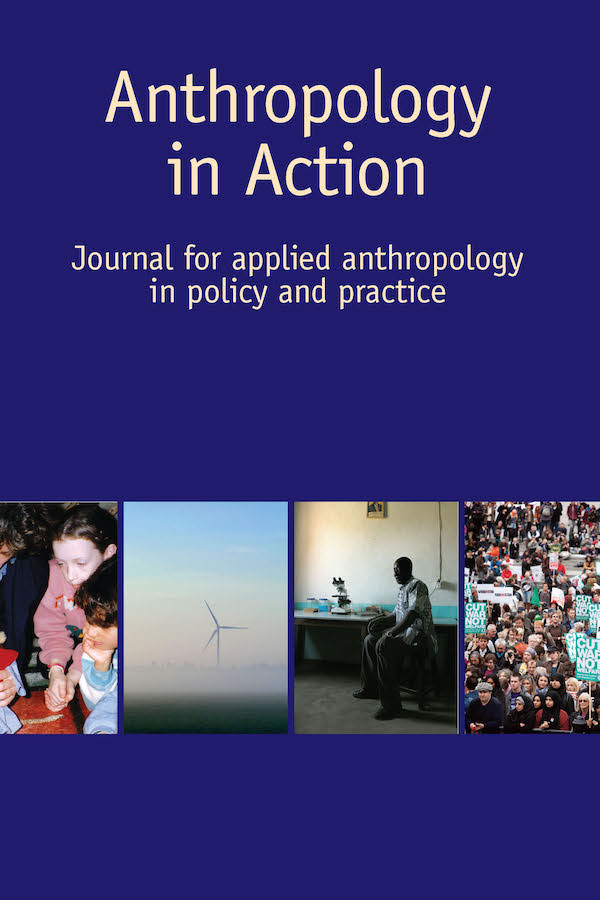
Anthropology in Action
Journal for Applied Anthropology in Policy and Practice
ISSN: 0967-201X (print) • ISSN: 1752-2285 (online) • 3 issues per year
Volume 17 Issue 1
Get 35% discount when you checkout 3 or more PDF articles.
Unsystematic Systems
This special issue reports the findings of a research team of senior anthropologists, Vered Amit and Noel Dyck, and three graduate research assistants, Heather Barnick, Meghan Gilgunn, and Kathleen Rice, collaboratively investigating the workings of policies on the movements of student and youth from Canada. Specifically our focus is on three different types of movement: international student exchanges, working holidays, and international athletic scholarships. While our focus is on movement out of Canada, these are, to say the least, forms of mobility that have their analogues, sometimes on a much larger scale, in many other affluent industrial countries.
Student Mobility and Internationalisation
Rationales, Rhetoric and 'Institutional Isomorphism'
Drawing on interviews with Canadian and Australian officials, this article examines the frame of student mobility within the broad discourse of internationalisation. Difficulties in definition and admitted shortfalls in achieving progress even on the more easily articulated benchmarks of student mobility, do not seem to staunch the enthusiasm of a variety of officials for the idea of internationalisation. This article will examine some of the contradictions framing these institutional discourses of internationalisation. These include the gaps between institutional claims and their substantiation, between lauding the internationalism inculcated by student mobility programmes and the more mixed motivations or engagements of student clients, and between claims for the entrepreneurial potential of internationalisation as against the uncertainty of its outcomes. I argue that a long-standing Western view of travel as a vehicle for self-cultivation and transformation combined with competitive efforts to keep up with perceived trends in the fields of post-secondary education are producing a momentum that is elusive even as it threatens to bulldoze its way across important institutional practices and procedures.
Managing Time and Making Space
Canadian Students' Motivations for Study in Australia
This article examines the ways in which Canadian students on an exchange or study abroad programme in Australia articulated the value of their experience in connection with time and, more particularly, time constraints. Where Canadian universities often promote study abroad programmes in connection with the global knowledge-based economy, students' desires to travel abroad were more often rooted in a desire to take 'time out' while remaining productive towards the completion of future goals. Students' narratives reveal a connection between time management, travel, and the formations of a class identity. Rather than analysing time strictly as a form of capital, however, insights are generated around time as practice, that is, how time becomes an important factor in students' continual negotiations of space, social relationships, and what could be called a 'lifetime itinerary'.
'Working on Holiday'
Relationships between Tourism and Work among Young Canadians in Edinburgh
Working holiday-maker programmes have facilitated a growing cohort of mobile young people who have an ambiguous status as both worker and tourist. Drawing on ethnographic fieldwork conducted among Canadian working holiday-makers in Scotland, this paper shows how working holiday-makers are situated in an ambiguous, contradictory position as working tourists, and are streamlined towards particular social and professional fields in which work-leisure boundaries are blurred. Although these blurred boundaries seem contradictory, they benefit employers who require an educated yet temporary work-force, while also meeting the desires of working holiday-makers for a lifestyle that is flexible, social, far from the pressures of friends and family, and that puts them in regular contact with other young foreigners who, like them, are at transitional points in life.
Going South
Canadians' Engagement with American Athletic Scholarships
This article examines the dynamics and implications of Canadians' pursuit of and ambiguous engagement with athletic scholarships offered to elite athletes by American colleges and universities. After sketching in the broader social and cultural context within which the movement of Canadian athletes to the U.S. occurs, it considers ways in which reckonings of high achievement in sport and other fields of performance tend to be constructed in Canada in terms of transnational and global comparisons. By examining how and why innumerable Canadian children and youths, with the assistance of parents and other adults, come to focus upon the pursuit of American athletic scholarships, this article seeks to penetrate an ambivalent form of competition that rewards its winners by taking them away from their families and country for a period of years just as they enter adulthood.
'Obviously It's Worth It'
The Value of Being a Canadian Student Athlete in the U.S.A.
Each year, young, elite Canadian athletes travel south to attend American colleges and universities, funded in part by athletic scholarships. These 'student athletes' leave their home country to pursue opportunities they believe are only available in the U.S. The demands made on their time, finances, and personal wellbeing can be staggering. Yet for those who become student athletes, the value of the experience tends to be unquestionably identified as being 'worth it'. In this paper, I explore how this exhortation, repeated so readily by the individuals I interviewed during fieldwork in the U.S., reflects a complicated set of beliefs. This deceptively simple statement provides an entry point for understanding what Canadian student athletes find valuable about their experience and how they believe it affords them a degree of personal distinction that would have been impossible had they stayed in Canada.
Suffering Syndromes and the (Anti-)Social Body
Kilshaw, Susie (2009), Impotent Warriors: Gulf War Syndrome, Vulnerability and Masculinity (Oxford: Berghahn Books). ISBN 978-1-84545-526-2 (hardback only) xiv + 228pp. excl. Appendix, Bibliography, Index. £55.00.
Lambert, Helen and Maryon McDonald (eds.) (2009), Social Bodies (Oxford: Berghahn Books). ISBN 978-1-84545-553-8 (hardback only) 169pp. excl. Contributors, Index. £43.00.
Childbirth
Midwifery and Concepts of Time
Childbirth: Midwifery and Concepts of Time Edited by Christine McCourt Oxford: Berghahn Books, 2009, ISBN 978-1-84545-586-6 (hardback only) 272 pp. excl. bibliog., index. £55.00.
Books for Review
Anthropology in Action is always happy to hear from potential reviewers at all stages in their academic careers. Reviews are normally short – about 500 words – but a more in-depth review can also be planned if you wish. We currently have a number of books awaiting review. If you are interested in reviewing any of the books on the list below, please feel free to get in touch. Alternatively, if there is a particular book you would like us to request please contact Michaela Benson (michaelacbenson@googlemail.com).