PDF issue available for purchase
Print issue available for purchase
ISSN: 2374-7552 (print) • ISSN: 2374-7560 (online) • 2 issues per year
This issue of
The Feminist New Wave refers to a movement defined by Creed as films directed primarily by women that explore central female characters in revolt against patriarchal values challenging what it means to be a woman under these conditions. Three films are explored in this article;
In Coralie Fargeat's 2024 film, the titular “substance” is a seductive product that promises Elisabeth Sparkle, a fitness instructor and television icon played by Demi Moore, a “younger, better, more perfect” you. Fargeat's film is the first of its kind to use body horror as a powerful condemnation of the ever-accelerating commodification of women's appearance under late capitalism, and the violence inflicted on its constituents. This article explores a history of feminine expression of violence inscribed on the self through art and film, especially in the New French Extremity. Turning to a discussion of the abject and the monstrous-feminine using the work of Julia Kristeva and Barbara Creed, this intervention shows how Fargeat's deployment of body horror graphically brings into sharp focus the violence of the ideal female commodified body, ending in an explosive confrontational indictment of what Laura Mulvey calls “to-be-looked-at-ness.” This article seeks to complicate and elaborate on the accelerated commodification of the female body as demonstrated by Fargeat's mobilization of the body horror genre.
As one of the most notorious franchises in horror history,
Claire Denis's 2019 film
Comparatively analyzing the representation of bodies in atomic bomb films,
In
Melodrama can be a productive genre for excavating and troubling social categories beholden to white heteropatriarchy, but the genre's disruptive power is not typically extended to trans films. Rather than utilizing melodrama's archetypal emotional spectacle to draw attention to genders’ incoherence, mainstream cinema relies on melodramatic tropes and sentimental pedagogy to engender pity for the preternaturally melancholic trans figure. Anxiety about the trans body, whether personal or cultural, therefore becomes the definitive mode for representing trans experiences on-screen. Given the genre's transnormative history, in particular its ambiguous treatment of trans femininity, how might filmmakers reclaim melodrama's critical social voice in service of a more radical trans agenda? And how might interventions by other spectacle-driven genres, like the musical, facilitate a more productive engagement with trans culture?
In survival horror games, the player is supposed to win by surviving but in Red Barrel's 2013 game
This is the tenth year of
On social media sites, both digital bodies and user to user experiences continuously destabilize the binaries life/death (or living/dead). The slippage of life/death digital social media members experience is made particularly salient in Sally Wen Mao's poem “Live Feed.” In the poem, the unnamed speaker is a personified piece of uploaded information—a nonliving actant—circulating in a social network's live feed, the place where information is devoured. I define this experience as “zombie hunger” as it applies to digital social network use and develop better language to trace self-representation on Facebook and Instagram and the material, embodied, and laboring human/nonhuman forces that allow for this body of knowledge to be accessible.
This article examines some of the self-portraits that Inès Bouallou, a young, Moroccan autodidact, has posted to Instagram. Bouallou sometimes calls her posts “autopoetry,” arguably one of autotheory's related genres. Through the lens of autotheory, which couples autobiography with theory, this article analyzes three features of Bouallou's autopoetic practice. She often cites literature alongside her self-portraits, thereby creating a dialogue between others’ words and her own life. In addition, Bouallou's self-portraits stage performances that put the self's coherence and stability into question. Finally, her photographs depict provocative instances of self-care, moments when the artist takes care of another incarnation of herself. Ultimately, this article aspires to inform autotheorists and others in the Global North of a comparable practice in North Africa.
The spectacle of war in the US-Mexico border is ubiquitously projected onto the screens that mediate our daily life, so that the screen (and the process of screening) becomes part of the discourses and material conditions of colonial capitalism, structuring our relationships with our and Other bodies. Xandra Ibarra's video performance in
Experiment No. 27 and others are each multiscreen choreographic components of the installation
This article explores Kelly Reichardt's
Although
Alzheimer's Disease (AD) is a condition that results in the slow deterioration of a person's memories and eventually their cognitive function. As this condition is so feared, there are several stigmas surrounding the disease. This article focuses on how neurogames, games that focus on neurological conditions where players play as either the patient themselves or alongside them and are developed for educational and entertainment purposes, may help address these stigmas and provide new means for expressing selfhood and consciousness.
This article examines Timothy Crick's notion of the game body, thinking beyond the visuality that defines cinematic “film body,” an embodied subject–object that mediates the sensation of a film to the viewer. Examining
This exhibition review of Kara Walker's
Violet Lucca,
Welcome, readers, to the final installment of the ninth volume of
This article reimagines discourses around race and gender within collaborative cultural productions by investigating how trauma is computed via visual images and human-computer interactions. I argue the use of digital collaborative formations—particularly that of oppositional writing in socially mediated spaces—provokes modes of encounter that enact a shared distributed experience of different ways of printing new paths in and out of trauma. By analyzing the digital storytelling taking place in “Breonna's Garden,” an augmented reality application that tells the story of Breonna Taylor, I clarify how digital technologies serve as an avenue for transformative recoding of the mechanisms of racialization.
Twitter's 2015 change from the star to the heart button caused many participants to antagonistically respond. This modification was supposed to enable participants’ easy and frictionless engagements. Nevertheless, it caused friction, including journalists’ identification as dismissed super users who were contaminated by the heart's feminine references. I employ close reading to study news stories, posts, and Twitter's narratives about the buttons. I cite academic scholarship on friction, feelings, buttons, and gender scripts as a means of arguing that Twitter's heart button was sometimes understood as frictionless, but it was also refused because of negative connotations. While such scholars as Sebastián Lehuedé and José Medina argue that individuals can employ friction to intervene in intolerance, my humanities study underscores how gender and sexuality norms are reproduced.
This article interrogates how TikTok has become a voice of authority in the self-diagnosis of ADHD and builds on theories of social, cultural, and algorithmic authority, to offer a theoretical framework of “techno-cultural authority”. Through a digital ethnography and analysis of ADHD TikToks and the technological infrastructures and assemblages surrounding the TikTok app, I demonstrate how ADHD TikTok content creators adopt visual and discursive norms from other trending TikTok content and traditional visual media content to generate authority, and to ensure their videos are deemed viewable and relevant by viewers and the algorithm. Contrary to traditional understandings of medical authority, I find that authority on TikTok is not produced by individuals or institutions, but rather by content creators who engage, en masse, with the supporting technologies of the TikTok app to reproduce familiar trends and visual norms.
This article explores women's re-appropriation of the national discourse of history and heritage in contemporary China. Examining women artists’ recreation of Silk Road heritage objects, I demonstrate how they produce a new narrative of women's time that, in turn, generates an alternative form of agency. In remaking the figure of the
In the early 2020s, queer cannibalism rose in significant popularity with films such as Luca Guadagnino's
Anxieties generated from the challenges of sustainable and equitable societies and the hopes for transcending routes through uncertain times have often found their paths crossing within the motion sequence of the dystopian car chase on film. Each decade has met this crossing—of frightening futures and fleeting freedoms—with its own set of driving rules and transport-based dimensions. From
This article examines the series
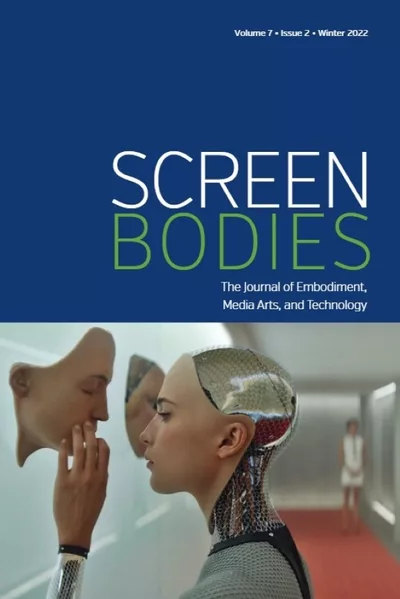
We are pleased to present an excellent collection of articles that represent the newest directions in what Barbara Stafford called “body criticism.” The authors in this issue of Screen Bodies work in diverse fields and employ a wide range of methods, but all share a concern with spectatorship and the ways that the effects of screen-based technology are mediated by the body. This research centers women and offers advancements in feminist film theory, posthumanism, and studies of the horror genre.
In recent years, many scholars of performing arts, cinema, and mass media have been focusing their studies on the body, examining the perception of the physical experience of projection and connecting bodily states with spiritual and ethical constructs. The purpose of this article is to present how cinema and performance can utilize the body in ways that enhance the audience's empathy. The role of cinema is to enable the viewer to liberate their body from its “individual ownership” and to rediscover its potential. Similarly, performances challenge the audience to respond with their bodies to the stimulation of certain emotions, experiencing a pure sensation through participation. However, experiencing empathy, a viewer can impose their ideas or reactions onto the experiences or emotions of others, believing that what they are experiencing is what others experienced.
Building on Paul Schrader's thesis in
This article examines the inter-subjective touch in Ildikó Enyedi's film
French film director and screenwriter Julia Ducournau's sophomore body horror film,
Posthumanism stands as a complex and interdisciplinary intellectual movement that challenges and broadens conventional notions of human identity and existence, particularly in light of advancements in science and technology. It emerged in response to the swift evolution of technology and its profound impact on our understanding of what it means to be human. Embarking on a posthumanist inquiry, this research delves into the rich fabric of Charles Stross’
This article looks at how the “anorexic condition” gained public awareness through popular culture, specifically in the United States and Hong Kong, and argues that the 1980s saw the beginning of anorexia awareness-raising in the American public, contributed by the untimely death of Karen Carpenter and the rapid expansion of consumerism. It uses racial, feminist, and disability theories to interrogate how their intersections defined and continued to shape anorexia. It examines the paradox that popular culture could be the very same agency that creates both such oppression and the “redemption” of its problematic consequences. This leads to a critical evaluation of the nature of popular culture, its influence on young people and their body image, and its prevailing influence on global society.
Asian women are often marginalized in global contexts, and they are often disembodied or presented in sexualized images in film and television productions. Even in the Asian region, Asian women have difficulty giving themselves a voice in popular culture. This essay has selected three films and tends to explore the gender connotation, body, and sexuality in the film works of East Asian female directors in recent decades, with the intent to explore the female sexual desire that is expressed and reflected in those female directors’ works.
The main object of study in this research is the cutting of the female body in cinema. In order to simplify and rationalize such a broad and diffuse concept, it is necessary to redesign a methodology of analysis valid for the object of study at hand, which will be called the Triple Cut. This will advance self-referentially, as if it were Russian dolls, from the cut of the real itself, passing through the cut of the plane (or between planes) or the absence of the same, until arriving at the cut of the flesh itself. This is where the bodies end up being dismembered live in front of the camera's lens, pouncing like pieces of meat on the—willing or unwilling—audience.
This issue of Screen Bodies features articles that contribute to a group of closely related critical concerns, namely, the existential and political significance of tacticity, feeling, and the representation of embodied experience. In her article, “Feeling Like Death,” Caitlin Wilson examines the aesthetic strategies Agnes Varda employs in two early films, La Pointe Courte (1955) and Le Bonheur (1965), that emphasize “textures and tactility” in the portrayal of mortality, death, and mourning. Wilson shows how Varda uses haptic imagery and calculated cinematic techniques to convey an experience of grief that is “palpable as well as visible.” Wilson persuasively argues that Varda depicts the embodied feeling of mortality to create a heightened sense of intimacy between the films’ characters. Similarly, in her timely article, “Gut Feelings,” Jennifer Jasmine White argues that Sheena Patel challenges the trend towards emotional indifference or “flatness” in the emerging genre of “internet novels.” In contrast to the affectless, numb, and apathetic heroine characteristic of novels like Lauren Oyler's Fake Accounts (2021) and Ottessa Moshfegh's My Year of Rest and Relaxation (2018), Patel's I'm a Fan (2022) features a more realistically emotional protagonist. White argues that the novel functions as an intervention that opposes affective indifference and the political apathy it inspires. She writes that most examples of the so-called internet novel, that is, literature that focuses on social media, influencer culture, and characters who are chronically online, suggest highly mediated social experience leads to emotional and political malaise. Patel rejects this trend and instead centers “the feeling body,” the embodied experience of life online, and the political agency it fosters.
Agnès Varda's early narrative films are texturally rich meditations on love and mortality. Each film uses aesthetic strategies that lend a palpability to the heartbreak, grief, and loss explored therein. This article examines how Varda's use of hapticity makes the morbid enticing, luring the viewer closer to the films’ surface. I particularly examine how these films balance narrative storytelling alongside palpable images, investigating whether films are seen, felt, or both simultaneously.
This article reads
Online users devise different strategies and techniques to make up for the absence of physical bodies in online communications, one of which is using emojis. Emojis are a diverse set of small images, symbols, or icons, standardized by the Unicode Consortium for utilization in electronic communication platforms. Their primary role is to effectively convey the emotional attitude of the writer, succinctly provide information, and playfully communicate messages. This article posits that bodily emojis (emojis portraying a body gesture or facial expression) are a form of digital embodiment. Their usage, thus, creates a form of digital performance. Emojis appear as a screen body in a space that lacks the physical one. Furthermore, I suggest that this body could be described as aesthetically Baroque. My proposition is that emojis exhibit Baroque characteristics such as dynamic and exaggerated forms and decorate texts. Emojis share similarities with the appearance and function of the Baroque body both in Baroque visual art and Baroque dance.
Theorist Lauren Berlant defines inconvenience as an affect, one exerted by dominant forces onto subordinate populations. In the same way subordinate populations exert inconvenient affects as well, creating a dynamic of dominant and subordinate inconvenience through which social power relationships may be understood. Following this structure, this article charts the dominant and subordinate affects exerted by capitalism and trans* bodies, respectively, and how capitalist oppression responds to and shapes trans* embodiment. Through an autotheoretical lens, this relationship is here examined in the 2020 film
The monster-as-queer trope in horror cinema historically implemented the binary of self-versus-other as heterosexual heroine versus queer monster/villain. With the rise of queer creators and spectators within horror, this trope was questioned so that the queer(ed) monster became multifaceted. From its birth, the horror anthology series
Categorized by what Michel Foucault called the “biopolitics” of life, the modern human body is reborn into a defamiliarized incarnate social entity that embodies an ecology of different kinds of augmentations. How do the mechanisms of biopolitics create normalized bodies and identities, and what are the real stakes of this new biopolitical power? This article investigates a genealogy toward the contemporary definition of identity and how biopolitics induces and creates a modern milieu of dualities. It then proposes a concept of “fluid identities” as a disruptive, provocative, and whimsical design intervention. It recognizes fluidity to be a presumed agentic human condition and a widely acceptable social factor; it recognizes identities to be “fragmented yet authentic” and “incomplete but sufficient.”
Steffen Hven, Enacting the Worlds of Cinema (Oxford: Oxford University Press, 2022). ISBN: 978-0-19-755510-1. pp. 216. $75.