 Get New Issue Alerts
Browse Archive
- Vol 34 Issue 2
- Vol 34 Issue 1
- Vol 33 Issue 2
- Vol 33 Issue 1
- Vol 32 Issue 2
- Vol 32 Issue 1
- Vol 31 Issue 2
- Vol 31 Issue 1
- Vol 30 Issue 2
- Vol 30 Issue 1
- Vol 29 Issue 2
- Vol 29 Issue 1
- Vol 28 Issue 2
- Vol 28 Issue 1
- Vol 27 Issue 2
- Vol 27 Issue 1
- Vol 26 Issue 2
- Vol 26 Issue 1
- Vol 25 Issue 2
- Vol 25 Issue 1
- Vol 24 Issue 2
- Vol 24 Issue 1
- Vol 23 Issue 2
- Vol 23 Issue 1
- Vol 22 Issue 2
- Vol 22 Issue 1
- Vol 21 Issue 2
- Vol 21 Issue 1
- Vol 20 Issue 2
- Vol 20 Issue 1
- Vol 19 Issue 2
- Vol 19 Issue 1
- Vol 18 Issue 2
- Vol 18 Issue 1
- Vol 17 Issue 2
- Vol 17 Issue 1
- Vol 16 Issue 1
Anthropological Journal of European Cultures
(formerly: Anthropological Yearbook of European Cultures)
ISSN: 1755-2923 (print) • ISSN: 1755-2931 (online) • 2 issues per year
Published Open Access as part of the Berghahn Open Anthro collection.
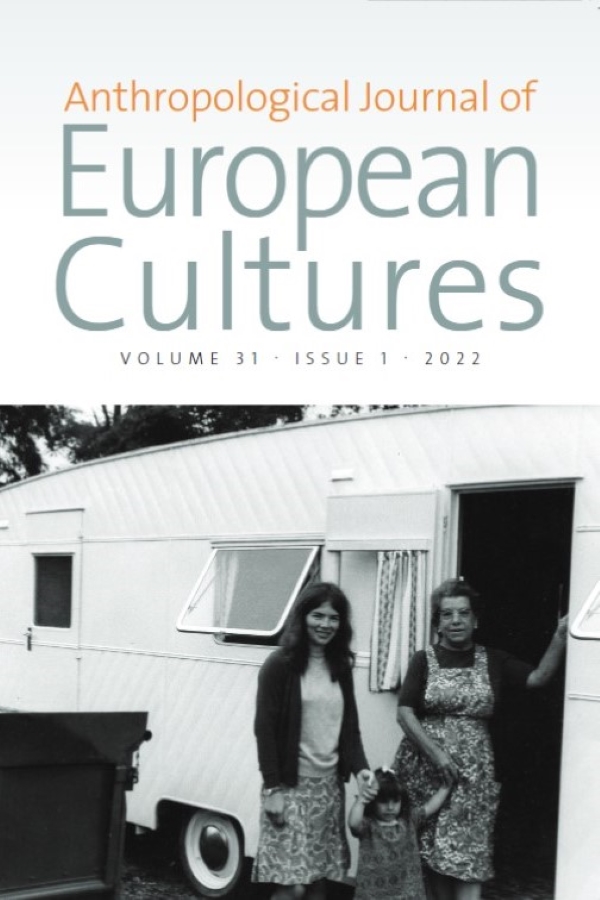
The year 2022 marks the 30th anniversary of the release of Helen Callaway and Judith Okely's edited anthology My anthropological journey has consisted in movement not only between different disciplines, but also between languages, countries and continents. This has involved stories of identity (imagined, constructed, or both), changes of place (teaching in six countries on three continents, and in four languages), searches for a safe haven, and belief in understanding the motives that govern human beings. In this wonderful journey, my coming to the In the 1980s, the theme for a future ASA conference had to be personally proposed by a potential organiser at the conference two years earlier. The proposer had to personally convince attending participants, who decided by a visible vote of hands. This recollection on the theme ’‘Anthropology and Autobiography’’ traces the successful 1987 vote for the 1989 conference proposed by myself with Helen Callaway. Before the vote, there were many negative comments claiming our proposal was mere ‘navel-gazing’ and a ‘feminist plot’. Inspired by the problematisation of the use of ‘I’ in Clifford and Marcus’ ‘ This article employs an anthropology ‘at-home’ approach to discuss dimensions of social and cultural changes amongst women in post-transitional societies. By applying person-centred ethnography, we aim to provide rich insights into the socio-cultural context and individual development of a young woman in Croatia. We examine how a young woman reasons about what kind of a person she is and wants to become by comparing the different sets of basic values that she ascribes to her emancipatory efforts, with a focus on how she juxtaposes ‘traditional family roles’ and ‘feminist values’. The article thus describes how this woman (Jadranka) experiences life challenges and shapes social values in her everyday cultural settings. This auto-ethnographic/biographical account deals with the experiences that a non-flying Northern-Ireland-born anthropologist living in the Baltic States has of mobility, infrastructure and connectedness, in particular with reference to academic and personal life. The article considers the movements which a career as an academic anthropologist requires, as well as the difficulties and intricacies that being located in Eastern Europe has for such land travel. Based on years of experience, it questions travel time and cost with particular reference to the seeming need to travel towards Western Europe in order to remain connected to the discipline's main ‘movements’. The article also examines solutions such as the Via Baltica, and looks forward to improvements that new infrastructure (such as high-speed railways) can bring. This article discusses the usefulness of critical analytical auto-ethnography in studying migrant (im)mobilities in the context of the COVID-19 pandemic. Whereas the auto-ethnographic genre has boomed during COVID-19 times, the authors of auto-ethnographic texts usually focus on their own experiences of the pandemic, engaging in an evocative style of writing. Following an overview of auto-ethnographic writing genres, this article discusses complex issues of insider/outsider status in pandemic research. It calls for a critical and analytical auto-ethnographic approach to the study of migrations and mobilities in a context in which they are currently unevenly distributed. A three-act session of storytelling, this visual essay explores the connection between photographs (and images at large) and death. A piece of authobiography, it follows the intimate journey of the author accompanying his father's departure first and his own grief later. The article positions photographs as objects that are more than mere representations. They are living things that accompany us during our lives. And photography, the author suggests by looking at photographs taken by himself, is a way for opening up time and acknowledging the present. Photographs are capable of bridging the gap between life and death. A duo-biographical recollection of an encounter, this article comprises a dialogue between the authors. On the one hand, it is about a shared moment – a tandem ‘go-along’ tour of the The beginnings of the interview date back to 2019, the year when we commemorated the 50th anniversary of the publication of Aleksandar Bošković (2021), Christiana Constantopoulou (ed) (2020), Julie L. Drolet (ed) (2019), Eszter Krasznai Kovacs (ed) (2021), Ulrich Kasten and Grażyna Kubica (2021), Volume 31 Issue 1