 Get New Issue Alerts
Browse Archive
- Vol 41 Issue 2
- Vol 41 Issue 1
- Vol 40 Issue 3
- Vol 40 Issue 2
- Vol 40 Issue 1
- Vol 39 Issue 3
- Vol 39 Issue 2
- Vol 39 Issue 1
- Vol 38 Issue 3
- Vol 38 Issue 2
- Vol 38 Issue 1
- Vol 37 Issue 3
- Vol 37 Issue 2
- Vol 37 Issue 1
- Vol 36 Issue 3
- Vol 36 Issue 2
- Vol 36 Issue 1
- Vol 35 Issue 3
- Vol 35 Issue 2
- Vol 35 Issue 1
- Vol 34 Issue 3
- Vol 34 Issue 2
- Vol 34 Issue 1
- Vol 33 Issue 3
- Vol 33 Issue 2
- Vol 33 Issue 1
- Vol 32 Issue 2
- Vol 32 Issue 1
- Vol 31 Issue 2
- Vol 31 Issue 1
- Vol 30 Issue 2
- Vol 30 Issue 1
- Vol 29 Issue 2
- Vol 29 Issue 1
- Vol 28 Issue 2
- Vol 28 Issue 1
- Vol 27 Issue 2
- Vol 27 Issue 1
- Vol 26 Issue 2
- Vol 26 Issue 1
- Vol 25 Issue 2
- Vol 25 Issue 1
- Vol 24 Issue 2
- Vol 24 Issue 1
- Vol 23 Issue 2
- Vol 23 Issue 1
- Vol 22 Issue 2
- Vol 22 Issue 1
- Vol 21 Issue 2
- Vol 21 Issue 1
- Vol 20 Issue 2
- Vol 20 Issue 1
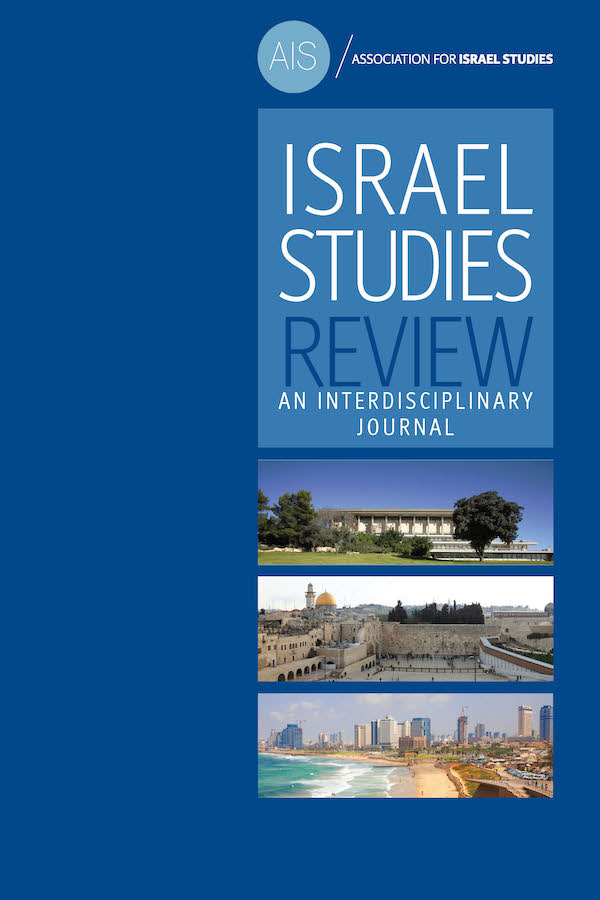
Israel Studies Review
An Interdisciplinary Journal
ISSN: 2159-0370 (print) • ISSN: 2159-0389 (online) • 3 issues per year
Published Open Access as part of the Berghahn Open Society collection.
This article looks at how Israelis and American Jews—politicians, state officials, rabbis, public figures, and the press—viewed Henry Kissinger in the months during and a after the Yom Kippur War of 1973. The expectations of Kissinger reflect the endurance of certain attitudes in Jewish political culture, which saw him either as an advocate on behalf of the Jews with the gentile powers that be, or as the influential yet alienated Jew willing to betray his people. Kissinger himself sometimes turned his Jewishness into a potent tool to advance his policy goals in confidential conversations with American officials, American Jews, Israelis, and Arabs. Yet Kissinger's relation to his Jewish identity was not only used as an instrument, but also defined who he was, regardless of whether or not he admitted it. The article critically examines Mapam's activity regarding the Military Government imposed on Arab-populated areas between 1948 and 1966. It analyzes and compares the party's declared stand and its parliamentary activity with the role played by the issue as a factor in coalition negotiations. The article contends that the issue of the Military Government did not serve as a crucial factor in Mapam's decision either to join the coalition or to stay out of it. It also claims that Mapam did not have a direct influence on the actual decisions concerning the Military Government, due to Mapai's dominance in the Israeli political system in those years. The article suggests that the case of Mapam and the Military Government sheds light on the modus operandi of the Israeli political system prior to the Six Day War, on the extent of Mapai's dominance of the political system in Israel prior to the 1977 political upheaval, on the limited role and influence available to small parties in a dominant party system, and on the inherent conflict and potential collision between security considerations and democracy. This article analyzes decision making in national security cases on the Israeli Supreme Court and draws broader comparative conclusions. In the post-9/11 era, security has topped the national agendas in numerous established democracies, with repercussions involving their courts. Analyses of decision making on national security in Western judiciaries may benefit from lessons from the Israeli Court, which has been a pivotal player in this domain. A formal model analyzes how internal court institutions plus the rationality of individual justices are conducive to strategic Court behavior. Predictions are tested empirically using an original database with security decisions from 1997 to 2004. The findings indicate that constitutional design, Court leadership, ideology of the ruling coalition and interest group activity have influenced decisions of the Israeli Court on national defense. This study builds on and expands existing scholarship on the complex links among law, politics, and national security in Israel and beyond. In the Knesset elections of 2009, what lay in the balance were not only significant programmatic differences between the main parties but the center of gravity of the party system and the direction from which the country is to be governed. Nevertheless, the three major rivals conducted a valance competition appropriate for situations in which the parties are ideologically close, and no questions of magnitude hang in the balance. This resulted from an unspoken agreement about the use of "tacit issues": rewards of the competition that are understood by stalwarts, and toward the attainment of which the rivals direct their e orts, but that are not spelled out to the wider public. Consequently, the campaign was among the shortest and least substantive in the country's history, but its outcome may determine the ideological direction of the country, the shape and steering capacity of its government, and the fate of the party system for a long time to come. Gershom Gorenberg, Th e Accidental Empire: Israel and the Birth of the Settlements, 1967–1977 (New York: Times Books, 2006). Idith Zertal and Akiva Eldar, Lords of the Land: The War over Israel’s Settlements in the Occupied Territories (New York: Nation Books, 2007). Hagai Huberman, Against All Odds: Forty Years of Settlement in Judea and Samaria, 1967–2007 (Ariel: Netzrim Publishing, 2008 [in Hebrew]). Farewell
Laurie Eisenberg Neil Caplan, The Israel-Palestine Conflict: Contested Histories
Review by Alan Dowty Rachel Feldhay Brenner, The Freedom to Write: The Woman-Artist and the World in Ruth Almog’s Fiction
Review by Avraham Balaban Jackie Feldman, Above the Death Pits, Beneath the Flag: Youth Voyages to Poland and the Performance of Israeli National Identity
Review by Noam Schimmel Michael R. Fischbach, Jewish Property Claims against Arab Countries
Review by Aviva Klen-Franke Asima A. Ghazi-Bouillon, Understanding the Middle East Peace Process: Israeli Academia and the Struggle for Identity
Review by Mira Sucharov Aviva Halamish, Meir Yaari: A Collective Biography: The First Fifty Years, 1987–1947
Review by Ilan Peleg Tamar S. Hermann, The Israeli Peace Movement: A Shattered Dream
Review by Gordon Fellman Alexandra Nocke, The Place of the Mediterranean in Modern Israeli Identity
Review by Karine Hamilton Ami Pedahzur and Arie Perliger, Jewish Terrorism in Israel
Review by Eran Schor Yaron Peleg, Israeli Culture between the Two Intifadas: A Brief Romance
Review by Philip Hollander Orit Rosin, Duty and Love: Individualism and Collectivism in 1950s Israel
Review by Michael Feige Nita Schechet, Disenthralling Ourselves: Rhetoric of Revenge and Reconciliation in Contemporary Israel
Review by Eran Fisher Amit M. Schejter, Muting Israeli Democracy: How Media and Cultural Policy Undermine Free Expression
Review by Dan Caspi Patricia J. Woods, Judicial Power and National Politics: Courts and Gender in the Religious-Secular Conflict in Israel
Review by Amnon CavariVolume 25 Issue 2