 Get New Issue Alerts
Browse Archive
- Vol 19 Issue 1
- Vol 18 Issue 2
- Vol 18 Issue 1
- Vol 17 Issue 2
- Vol 17 Issue 1
- Vol 16 Issue 2
- Vol 16 Issue 1
- Vol 15 Issue 2
- Vol 15 Issue 1
- Vol 14 Issue 2
- Vol 14 Issue 1
- Vol 13 Issue 2
- Vol 13 Issue 1
- Vol 12 Issue 2
- Vol 12 Issue 1
- Vol 11 Issue 2
- Vol 11 Issue 1
- Vol 10 Issue 2
- Vol 10 Issue 1
- Vol 9 Issue 2
- Vol 9 Issue 1
- Vol 8 Issue 2
- Vol 8 Issue 1
- Vol 7 Issue 2
- Vol 7 Issue 1
- Vol 6 Issue 2
- Vol 6 Issue 1
- Vol 5 Issue 2
- Vol 5 Issue 1
- Vol 4 Issue 2
- Vol 4 Issue 1
- Vol 3 Issue 2
- Vol 3 Issue 1
- Vol 2 Issue 2
- Vol 2 Issue 1
- Vol 1 Issue 2
- Vol 1 Issue 1
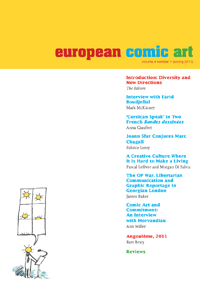
European Comic Art
ISSN: 1754-3739 (print) • ISSN: 1754-3800 (online) • 2 issues per year
Volume 4 Issue 1
Introduction
Diversity and New Directions
Future directions are often shaped by quirks of necessity or chance: the groundbreaking iconoclast that is Moebius’s Garage hermétique, with its rejection of conventional narrative or character coherence, came as a result of the author having forgotten previous scripts from one week to the next; Rodolphe Töpffer, so often credited for having invented the modern comic strip, initially saw himself as producing no more than scribblings for the entertainment of his pupils; one of the earliest of text/image forms, the emblem, may well be the result of Augsburg printer, Heinrich Steiner, adding images in 1531 to Andrea Alciato’s epigrams, a far cry from the composed intertwining of Francesco Colonna’s Hypnerotomachia Poliphili of 1499. Mirroring such processes in our own way, European Comic Art is embarking on a new direction, as we turn to issues that can reflect the diversity of comic art rather than being necessarily united by a single theme. It is a logical direction, but also one shaped by chance and necessity, that of the diversity of high-quality submissions that we have been delighted to receive.
Interview with Farid Boudjellal
Farid Boudjellal (b. 1953), a French cartoonist of Algerian and Armenian heritage, outlines his approach to comics. He discusses important inspirations and influences, including cartoonists from France (Gébé), Italy (Hugo Pratt) and the United States (Milton Caniff). He speaks of themes that are important to his work, especially temporality, a multiplicity of characters, dreams and fantasy. Boudjellal also distinguishes his comics from autobiography, a genre that he shuns, and critiques the sociological reductionism often found in the critical reception of his comics. He discusses his artistic techniques, including black-and-white line drawing, watercolor, and interconnected speech balloons. His interview provides an overview of his career and his ongoing projects in comics, which he situates against the general evolution of comics in France from the 1960s up to the present.
'Corsican Speak' in Two French Bandes dessinées, or How to Manipulate Communication Rules
A Pragmatic Analysis
The analysis of language in French comics has usually been carried out on questions such as variation (especially diastratic and diatopic), focusing on lexical and syntactical elements, but seldom has the question of communication rules been dealt with, despite the fact that these are paramount in the comical effects achieved by some bandes dessinées. We will therefore carry out our analysis by examining how it is possible to explain the achievement of such comical effects through the in-depth deconstruction of the functioning of communication rules, more precisely their apparent malfunctioning when two different communities of speakers are forced to interact: Corsicans and Pinzuti (the Corsican name for non-Corsicans).
Joann Sfar Conjures Marc Chagall
The Politics of Visual Representation in The Rabbi's Cat
The five episodes of Joann Sfar's The Rabbi's Cat (2002-2006), recently published in English translation in two volumes (2007-2008), and particularly the latest instalment of the series, Africa's Jerusalem, are rich in meta-narrative and meta-iconic elements. By staging various theological arguments about aniconism in Abrahamic religions, Sfar uses the comics medium to reflect on the prohibition of graphic representation in Judaism and Islam (following the Jyllands-Posten Danish cartoons controversy and the trial of the French satirical magazine Charlie-Hebdo ). He also distances his work from the usual Western stance on realistic mimesis and its pseudo-scientific epistemology by criticising the European constructs of race and exoticism. Between the anti-iconic prohibition of the East and the false iconicity of the West, Sfar finds a middle ground in the anonymous character of a Russian painter travelling through Africa in the 1930s, whose physical appearance and biographical background recall that of famous Franco-Russian Jewish painter, Marc Chagall. This article will explore how the painter's cultural hybridity and artistic idiosyncrasy allow Sfar to negotiate a perspective on graphic representation which resolves the problem of simulacrum as it is framed in this binary opposition. It will also discuss the manners in which Sfar borrows from Chagall's aesthetics and magic realism in the process, thus creating a new kind of image in the realm of comics.
A Creative Culture Where It Is Hard to Make a Living
The Socio-Economic Situation of Comics Authors and Illustrators in Belgium
On the initiative of the research office of the non-profit SMartBe Professional Association for Creative Professions, an exploratory survey into the current socio-economic circumstances of comics authors and illustrators in Belgium has been undertaken for the first time. The replies of 191 French-speaking and 72 Dutch-speaking artists to the online questionnaire have given an idea of the profile of comics authors and illustrators in Belgium (in terms of gender, age, place of residence, educational background), their professional activities and the type of publications in which their work appears, and their employment status and income. The results show that, in general, their monthly income falls below the Belgian median, and that many artists, particularly in the younger age range, are reliant on supplementing their earnings from other sources. A number of differences emerged between the situation of French-speaking and Dutch-speaking artists. The role of creative grants (especially subsidies from the government) is shown to be crucial.
The OP War, Libertarian Communication and Graphic Reportage in Georgian London
On 18 September 1809, Covent Garden Theatre reopened, lavishly decorated after the devastating fire of the previous year. Far from being an occasion of celebration, an increase in prices and the architectural redistribution raised the ire of London's theatregoers, sparking months of sustained protest. Known as the Old Price riots, these protests received widespread attention in the metropolitan press. They also prompted various responses from London's satirical print trade. This article will explore the output of these two publicly facing media with respect to the Old Price riots as means of examining the differing processes of reportage they functioned within. It will argue that despite operating on a 'virtual' plane of reportage, that during the Old Price riots graphic satire escaped the confines of its virtuality and became an active agent in Georgian anti-authoritarian protest.
Comic Art and Commitment
An Interview with Morvandiau
This interview with political cartoonist and comics artist Morvandiau focuses mainly on his 2007 comic book D'Algérie. After the murder in 1994 of his Uncle Jean, a père blanc ['white father'] in Tizi Ouzou, along with three of his fellow priests, followed by the failed suicide of his father, a Pied-noir, eight years later, Morvandiau decided to carry out research into his family and its links with France's colonial adventure. Through the resources of the comic art medium, he was able to give form to a story which is both personal and public (Figures 1-2). The subtle and sober portrayal of his search for identity is contextualised by a highly absorbing panorama of political events. In the interview, he explains some of the aesthetic choices that he made, and discusses the challenges of working from documentary material, and how he drew on the resources of the medium to tackle issues of individual and collective identity.
Angoulême, 2011
The 2011 Festival International de la Bande Dessinée (FIBD) in Angoulême saw the return of enormous crowds to the medieval town in south-western France, and for the first time in many years the event felt uncomfortably crowded and difficult to navigate. This year’s edition of the Festival benefited from a lack of major ongoing controversies. Past issues relating to funding from the town and department have been (at least temporarily) resolved, and the construction that disrupted the event for many years in the 2000s has been complete for some time now. Nonetheless, the show lacked energy and many of the exhibits came across as lacklustre. The major topic of discussion at the show was the strike by salaried employees of L’Association, an occurrence that hung a gloomy cloud over events.
Book Reviews
Simone Castaldi, Drawn and Dangerous: Italian Comics of the 1970s and 1980s Giuseppe Gazzola
Joel E. Vessels, Drawing France: French Comics and the Republic Karen J. Leader
Notes on Contributors
Notes on contributors